
By Sarim Suleman on May 21, 2026

Compliance for evidence is the practice of handling digital evidence so that it meets the legal standards a court uses to decide whether the evidence can be admitted. Compliance covers four conditions: authenticated origin, proven integrity, a documented chain of custody, and adherence to the applicable legal frameworks such as the Federal Rules of Evidence, ISO/IEC 27037, and the CJIS Security Policy.
A single lapse in any of these conditions, whether a broken chain of custody, missing authentication, or a procedural violation, gives opposing counsel grounds to challenge or exclude the evidence. For law enforcement agencies, prosecutors, and legal teams, that risk applies to every piece of body camera footage, surveillance video, interview recording, mobile device extraction, and digital document that reaches a case file.
This guide explains the legal frameworks that govern digital evidence in the United States, the conditions courts apply when ruling on admissibility, and the operational practices that keep evidence defensible.
What makes digital evidence admissible in court
Courts apply four conditions when determining whether digital evidence is admissible:
- Authentication. The proponent must show the evidence is what they claim it is, under Federal Rule of Evidence 901, or qualify for self-authentication under Rule 902.
- Integrity. The evidence must be demonstrably unaltered since the moment of capture, typically proven through hash verification and tamper-evident storage.
- Chain of custody. A documented record of every person who accessed, transferred, or modified the evidence from capture through presentation.
- Procedural compliance. The collection, storage, and disclosure must comply with the applicable rules of procedure, privacy laws, and any sector-specific standards that apply to the evidence type.
A file that is technically intact but was collected in violation of the Fourth Amendment, or stored in a non-CJIS-compliant environment by a law enforcement agency, may still be excluded. Compliance is the combined technical and procedural standard, not just one or the other.
Key legal frameworks governing digital evidence
Several federal statutes and rules apply to the handling of digital evidence. Which ones apply in a given case depends on jurisdiction, evidence type, and the parties involved.
Federal Rules of Evidence (FRE)
The FRE governs admissibility in federal court and is mirrored by most state codes.
Rule 901 requires the proponent to produce evidence sufficient to support a finding that the item is what they claim it is. For digital evidence, this typically means witness testimony, hash values, metadata, or distinctive characteristics that link the file to its source.
Rule 902(13) and 902(14), added by the 2017 amendments, designate two categories of digital evidence as self-authenticating. Rule 902(13) covers records generated by an electronic process or system shown to produce accurate results. Rule 902(14) covers data copied from an electronic device, storage medium, or file, verified by a hash value or other reliable digital identification. Both require certification by a qualified person and advance notice to the opposing party.
The 2017 amendments removed the requirement for live witness testimony to authenticate certain machine-generated and forensic digital evidence, which significantly streamlines admissibility for properly captured body camera footage, CCTV recordings, and forensic disk images.
Federal Rules of Civil Procedure (FRCP)
The FRCP governs electronically stored information in civil litigation.
- Rule 26 requires early disclosure of relevant ESI and limits discovery to what is proportional to the case.
- Rule 34 allows parties to request ESI in specified formats and requires production in a usable form.
- Rule 37(e) addresses failure to preserve ESI and sets the standard for sanctions when evidence is lost.
- Rule 45 governs subpoenas for ESI from non-parties.
CJIS Security Policy
The FBI Criminal Justice Information Services Security Policy applies to any system that stores, processes, or transmits criminal justice information. Requirements include AES-256 encryption at rest, encryption in transit, multi-factor authentication, role-based access controls, and detailed audit logging. Any platform used by a law enforcement agency to manage digital evidence must support CJIS-compliant deployment. For a practical look at how these controls apply to evidence workflows, see our guide on CJIS compliance in digital evidence management and the accompanying CJIS compliance checklist.
HIPAA
When digital evidence contains protected health information, HIPAA controls how that information is stored, accessed, and disclosed. This commonly arises in cases involving hospital surveillance, medical examiner records, or evidence from healthcare facilities.
Other frameworks
Several additional statutes affect specific evidence categories:
- Computer Fraud and Abuse Act (CFAA) governs unauthorized access to computer systems and can render evidence inadmissible if obtained through illegal access.
- Electronic Communications Privacy Act (ECPA) and the Stored Communications Act (SCA) govern access to electronic communications and stored communications such as emails and social media content.
- California Consumer Privacy Act (CCPA) and state-level privacy laws affect how personal data within evidence files can be handled and disclosed.
- ISO/IEC 27037 is the international standard for identification, collection, acquisition, and preservation of digital evidence. Increasingly referenced in cross-border cases and by agencies adopting formal evidence handling procedures.
Operational requirements for compliant evidence handling
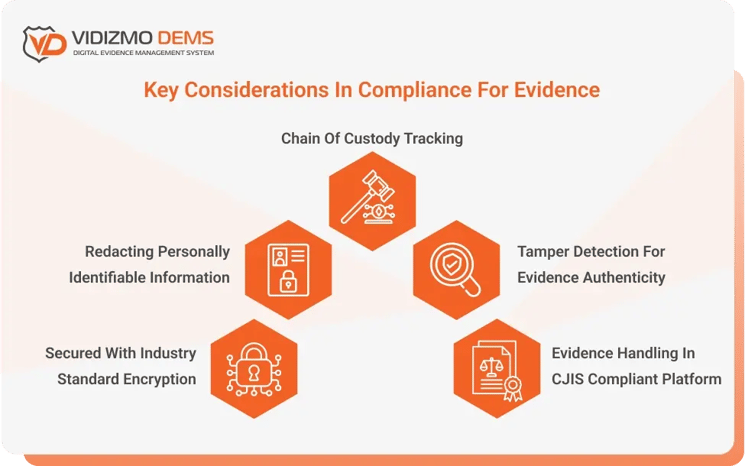
Meeting the legal standards above requires four operational controls. Each maps directly to one or more admissibility conditions.
Chain of custody documentation
An unbroken chain of custody records every transfer, access, and action taken on a piece of evidence from capture to presentation. The record must show who accessed the evidence, when, for what purpose, and what action they took. Gaps in this record are the most common grounds for evidence challenges and one of the most preventable. Manual logs and shared drives produce gaps. Purpose-built evidence management systems generate the record automatically. For a deeper look at how chain of custody gaps cause evidence to be excluded, see broken chain of custody: causes, consequences, and how to prevent it.
Hash-based integrity verification
Cryptographic hash values, typically SHA-256, are calculated at the moment of capture and recalculated at each handling stage. A matching hash confirms the file is bit-for-bit identical to the original. A mismatch indicates alteration. Hash verification is what allows digital evidence to qualify for self-authentication under FRE 902(14). See our guide on how to prevent digital evidence tampering for the broader set of integrity controls agencies use alongside hashing.
Encryption and access controls
Evidence must be protected from unauthorized access during storage and transmission. CJIS, HIPAA, and most state evidence-handling requirements specify AES-256 encryption at rest and TLS encryption in transit. Role-based access controls restrict access to authorized personnel and produce the audit trail that supports the chain of custody record.
Redaction of personally identifiable information
Before evidence is disclosed in discovery, released under FOIA, or shared with external parties, personally identifiable information that is not relevant to the proceeding must be redacted. This includes faces of uninvolved individuals, license plates, Social Security numbers, addresses, and protected health information. Improperly redacted disclosures create privacy liability and can themselves become grounds for sanctions. AI-assisted redaction tools have made this defensible at the volume modern evidence handling requires. For more on why agencies have moved to automation, see why automated redaction is critical for law enforcement.
When Courts Have Excluded Digital Evidence: Three Cases
Griffin v. State, 419 Md. 343 (2011)
Screenshots from a MySpace profile were offered to prove witness intimidation in a murder case. The Maryland Court of Appeals reversed the conviction, holding that the prosecution failed to authenticate the screenshots under Maryland's evidence rule. The court noted that anyone could have created the profile or posted the content, and the prosecution provided no extrinsic evidence linking the page to the defendant.
People v. Lenihan, 30 Misc. 3d 289 (N.Y. Sup. Ct. 2010)
MySpace photographs used during cross-examination were ruled inadmissible because the prosecution could not authenticate that the images had not been edited or altered.
Meth v. Natus Medical Inc
LinkedIn profile evidence offered in a wage and hour dispute was excluded under FRE 901 because the proponent failed to authenticate the profile content.
The common thread: each ruling turned on a Rule 901 authentication failure that proper hash verification, metadata capture, and chain of custody documentation would have resolved.
How to ensure compliance for digital evidence
The frameworks above require both procedural discipline and technical infrastructure. A digital evidence management system consolidates the controls that compliance requires into a single platform:
- Automated chain of custody logging for every access and action
- SHA-256 hash verification at ingestion and through every handling stage
- AES-256 encryption at rest and in transit
- Role-based access controls with detailed audit trails
- CJIS-compliant deployment options for law enforcement and government agencies
- AI-assisted redaction for video, audio, image, and document evidence
- Retention policies and legal holds aligned with applicable rules
Ensure Compliance for Evidence with Digital Evidence Management Systems
The growing importance of digital evidence in legal proceedings makes its role in almost every case inevitable. To ensure compliance, maintain the integrity of evidence, and streamline investigations, organizations must adhere to the proper practices.
By adhering to these guidelines, organizations can effectively manage digital evidence, bolster their investigations, and uphold the integrity of the justice system.
However, doing so requires robust secure storage and sharing provided by digital evidence management systems like VIDIZMO DEMS. VIDIZMO provides an IDC MarketScape-recognized Digital Evidence Management System. It simplifies the management of ever-increasing digital evidence by offering a CJIS-compliant secure platform to ingest, manage, and store digital evidence.
With chain of custody management, tamper detection, encryption, evidence transcription and translation, AI-powered search, redaction, and more, VIDIZMO DEMS provides a convenient platform for all compliance needs related to evidence handling laws.
Try VIDIZMO DEMS free for 7 days.
Ensure compliance for evidence with AI-powered VIDIZMO DEMS. Try VIDIZMO DEMS free for 7 days or contact us.
About the Author

Jump to

Video Evidence Authentication: Standards Courts Expect in 2026

Why Google Drive, Dropbox, and SharePoint Are Not Built for Evidence Management


No Comments Yet
Let us know what you think