

By Zahra Muskan on Jan 22, 2026 5:47:28 PM, Code:

Security operations today generate more video evidence than ever before. Surveillance cameras, body-worn cameras, access control systems, and mobile devices continuously capture incidents across public and private environments. Yet despite this abundance of footage, many security teams struggle to turn video into court-ready evidence.
The challenge is not capturing incidents.
The challenge is managing what happens after the footage exists.
AI in security operations is increasingly positioned as the answer. But without the right structure, AI can introduce new risks instead of reducing them. This article explains how AI should be applied across the full security evidence lifecycle, from surveillance to courtroom, to produce defensible, privacy-safe outcomes.
Key Takeaways
- AI in security operations must support investigations, not just monitoring.
- Surveillance video becomes risky when it lacks governance and traceability
- Court-ready evidence requires integrity, auditability, and controlled redaction.
- AI analytics and AI redaction must work together within evidence workflows.
- Security teams need end-to-end processes, not disconnected tools
Why Surveillance Video Alone Is No Longer Enough
Modern security environments are saturated with cameras. Airports, government buildings, campuses, retail chains, and city infrastructure rely on surveillance as a primary security control.
However, surveillance systems were designed to:
- Observe activity
- Record continuously
- Support basic playback
They were not designed to:
- Handle investigative workflows
- Preserve evidentiary integrity
- Support disclosure and court scrutiny
The National Institute of Standards and Technology (NIST) emphasizes that digital evidence, including video, requires special handling to avoid compromise, alteration, or loss of authenticity.
Once footage is exported, edited, or shared without controls, its evidentiary value begins to erode.
The Real Risk: When Surveillance Video Enters the “Messy Middle”
Between surveillance capture and courtroom presentation lies a dangerous gap. This is where most security operations struggle.
What Happens in the Messy Middle
Common scenarios include:
- Multiple exports of the same clip
- Copies shared via email or shared drives
- Clips trimmed or converted without logging
- Redactions applied without version tracking
- No clear record of who accessed or modified footage
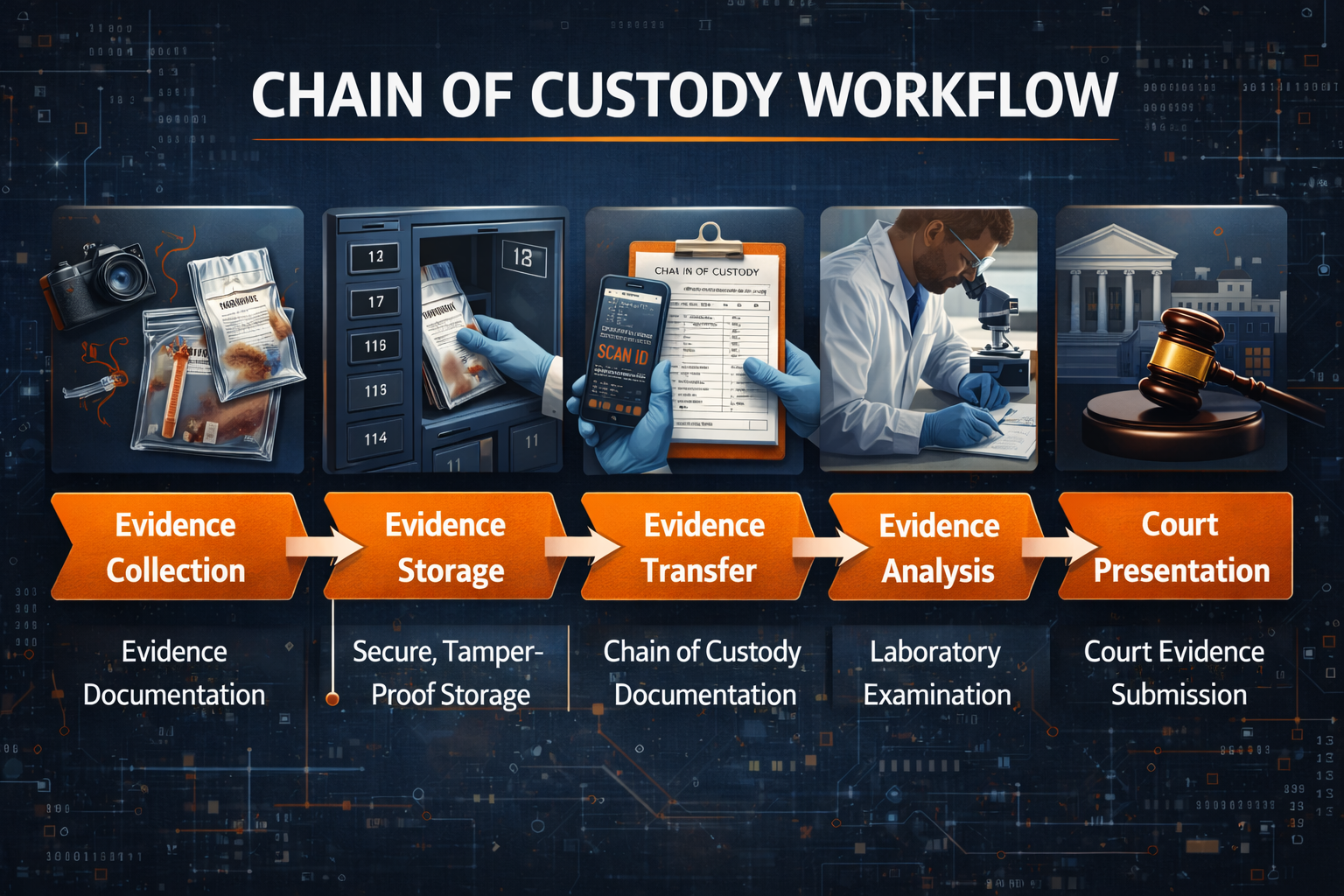
The Cybersecurity and Infrastructure Security Agency (CISA) defines chain of custody as a documented process that tracks control and handling of assets to ensure accountability and transparency.
Without this discipline, video evidence becomes vulnerable to challenge.
Court-Ready Evidence: What It Actually Means
“Court-ready” is not a format.
It is a condition.
For video evidence to be court-ready, it must demonstrate:
- Authenticity
- Integrity
- Continuity of control
- Documented handling
- Justifiable redactions
Courts and prosecutors increasingly question how digital evidence was collected, processed, and altered, especially in an era where AI-generated and manipulated media are real concerns. The National Center for State Courts has published guidance highlighting judicial scrutiny around AI-impacted evidence.
Security teams must now assume that how evidence is handled will be examined as closely as what it shows.
How AI Fits into Security Operations the Right Way
AI is not a single capability. In security operations, it serves different purposes at different stages.
Stage 1: AI for Surveillance Intelligence and Incident Discovery
AI video analytics help security teams:
- Detect motion and anomalies
- Identify objects, vehicles, and people
- Narrow hours of footage to relevant moments
This reduces manual review time and accelerates incident response.
However, AI analytics alone do not make evidence defensible. They simply help teams find what matters faster.
Public-sector reporting shows prosecutors and investigators increasingly rely on AI to manage growing volumes of digital evidence, but only when governance follows discovery.
Stage 2: AI for Evidence Preservation and Governance
Once footage is tied to an incident, it must be preserved as evidence.
This requires:
- Controlled access
- Immutable originals
- Audit logs
- Secure storage
NIST guidance stresses that evidence preservation must ensure that digital evidence is not altered and that its handling can be reconstructed if challenged. AI has limited value here unless paired with evidence management controls.
Stage 3: AI Redaction for Privacy-Safe Disclosure
Privacy obligations are now central to security operations.
Security teams must redact:
- Faces of bystanders
- License plates
- Personal identifiers
- Sensitive audio
- On-screen documents
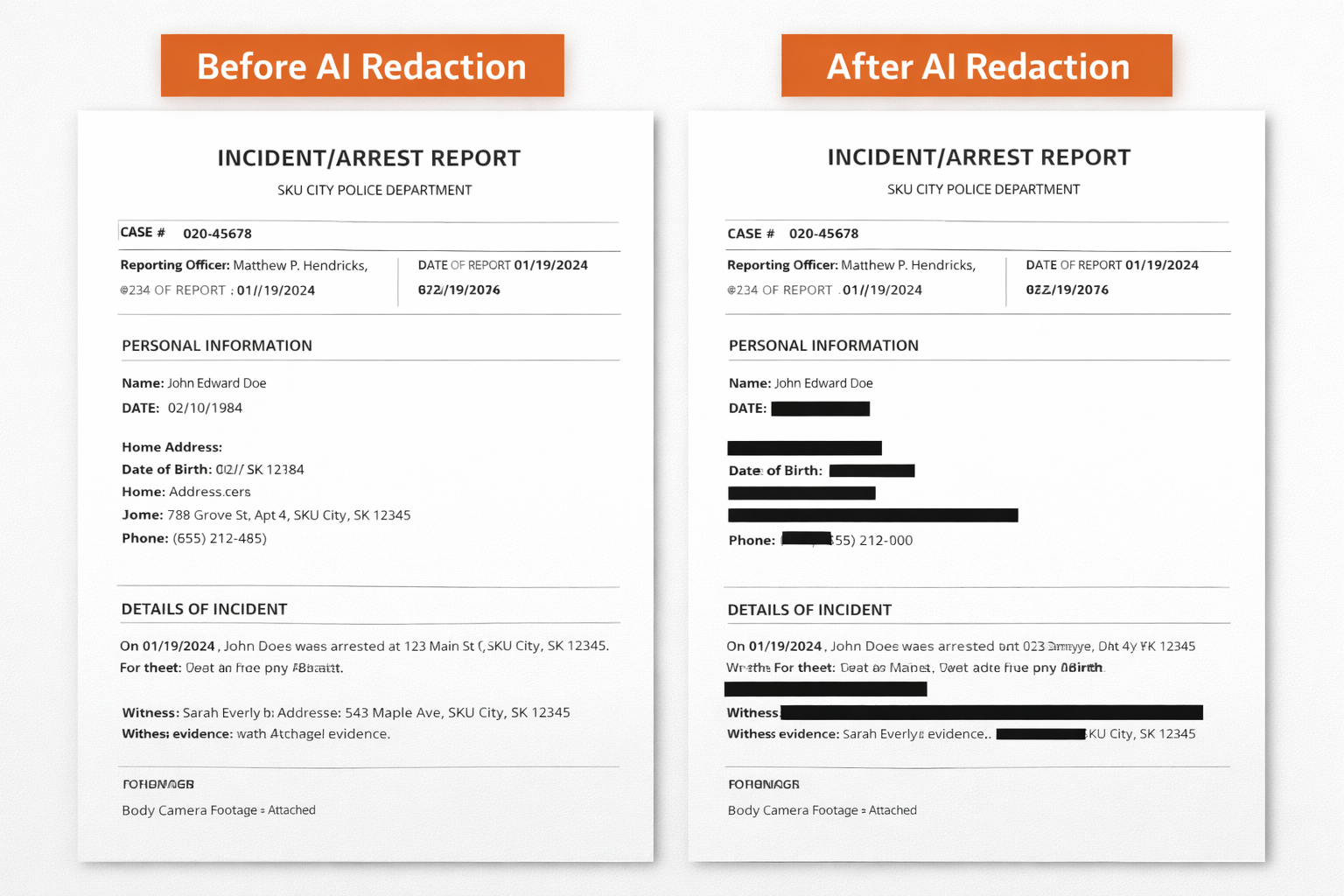
Manual redaction is slow and error-prone, especially across video, audio, and documents.
The Bureau of Justice Assistance (BJA) has repeatedly highlighted redaction challenges as a major operational burden in body-worn camera and public records programs.
AI redaction enables:
- Automated detection of sensitive content
- Consistent application of privacy rules
- Creation of defensible redacted derivatives
Crucially, redaction must never overwrite originals.
Comparing Security Evidence Management Approaches
Surveillance-Only Platforms
Strengths:
- Live monitoring
- Recording and retention
Limitations:
- No investigative governance
- Weak export controls
- No redaction accountability
Manual Evidence Handling
Strengths:
- Familiar processes
Limitations:
- High human error
- No scalability
- Inconsistent documentation
- High legal risk
Disconnected AI Tools
Strengths:
- Faster search or redaction in isolation
Limitations:
- Broken chain of custody
- Version confusion
- Difficult audits
Unified AI Intelligence and Evidence Governance
Strengths:
- AI-assisted discovery
- Controlled evidence lifecycle
- Auditable redaction
- Secure sharing
- Court-ready outputs
This approach aligns best with modern security and legal expectations.
Why End-to-End Matters
AI in security operations fails when applied as point solutions.
Using AI to find incidents without governing evidence creates risk.
Using AI to redact footage without tracking changes creates risk.
AI must be embedded into a defensible evidence workflow, not layered on top of broken processes.
How VIDIZMO Intelligence Hub and AI Redaction Fit This Model
VIDIZMO Intelligence Hub supports:
- AI-driven video search and investigation
- Centralized ingestion from surveillance and other sources
- Metadata enrichment for faster evidence discovery
VIDIZMO AI Redaction enables:
- Automated privacy protection across video, audio, images, and documents
- Policy-based redaction
- Preservation of originals with tracked derivatives
- Full auditability for disclosure and court review
Together, they address the full journey from surveillance to court-ready evidence.
Trust and Authority Signals That Matter
This approach aligns with:
- NIST digital evidence preservation standards
- CISA chain of custody principles
- BJA guidance on video evidence and disclosure
- Judicial scrutiny around AI-era evidence
Security operations that follow these principles reduce legal exposure and improve investigative outcomes.
Decision Guidance for Security Leaders
Ask yourself:
- How fast can we locate incident footage today?
- How many uncontrolled copies exist after an investigation starts?
- Can we prove who accessed and modified evidence?
- Are redactions consistent and defensible?
- Could we explain our process confidently in court?

Final Takeaway: AI Must Serve Evidence, Not Just Surveillance
AI in security operations delivers real value only when it supports the full evidence lifecycle.
The safest and smartest path forward is to:
- Use AI for faster discovery
- Govern evidence from the moment it matters
- Apply AI redaction for privacy-first disclosure
- Maintain auditability and chain of custody end to end
That is how surveillance footage becomes court-ready evidence in modern security operations.
Jump to

Enhancing Digital Evidence Security with AI-Based PII Redaction

Why Digital Audit Trails Are Critical for Modern Evidence Management


No Comments Yet
Let us know what you think