

By Zahra Muskan on Jan 22, 2026 4:25:32 PM, Code:
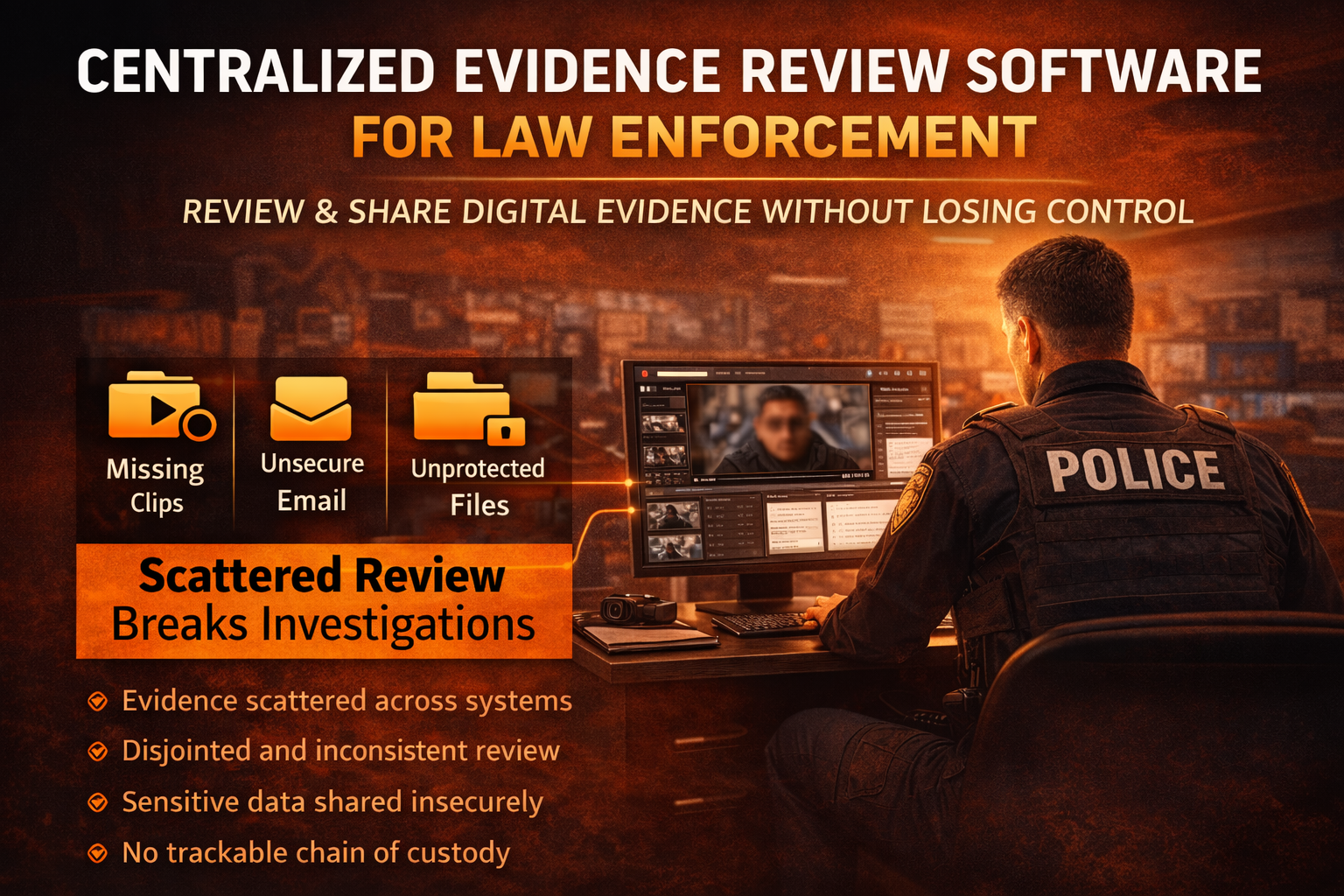
The case doesn’t fail in the street. It fails at the desk.
The most dangerous moment in a digital evidence workflow is not the incident.
It’s the handoff.
One missing clip.
One emailed attachment.
One “shared drive” folder with the wrong permissions.
That’s how agencies end up with delayed charging decisions, disclosure surprises, and credibility problems that cannot be fixed with better paperwork.
Centralized evidence review software for law enforcement exists because modern cases are not built on one report. They are built on dozens of videos, interviews, screenshots, CAD notes, and uploads that must be reviewed, clipped, shared, and defended.

Centralized evidence review software for law enforcement showing a case workspace
Why “scattered review” breaks investigations
In many agencies, evidence review looks like this:
- Body-worn camera video in one system
- CCTV in another folder or vendor portal
- Interview audio on a local drive
- Photos and documents in email threads
- Notes in RMS, but clips stored elsewhere
This is not just inconvenient. It creates three practical failures:
- You can’t move fast.
Review time balloons because everything is searched separately. - You can’t stay consistent.
Two people review the same case and pull different “key moments.” - You can’t prove control.
If access and changes aren’t tracked, chain of custody gets attacked.
Law enforcement evidence needs more than storage.
It needs review that is centralized, repeatable, and defensible.
3) How to centralize evidence review (step-by-step, built for real agency pain)
Here’s the workflow that centralized evidence review software should support in practice.
Step 1: Create a single “case workspace” for review
The case workspace, case-based evidence organization within a digital evidence management system, is where all relevant evidence is pulled together.
Video, audio, images, documents, and related metadata should be reviewed in one place, without jumping between systems or exporting files just to understand what happened.
Step 2: Standardize how reviewers mark what matters
Look for tools that let reviewers:
- Add timestamps and notes
- Tag key events (use-of-force moment, suspect statement, victim ID)
- Generate clips consistently
This is how you avoid “everyone has their own version of the truth.”
Step 3: Control access by role, not by convenience
Centralization without access control is just centralized risk.
Law enforcement environments commonly require CJIS-compliant security controls for protecting criminal justice information, especially when data is stored, accessed, or shared electronically.
Step 4: Make sharing defensible (prosecutors, courts, other agencies)
Secure sharing should include:
- Permissioned access (who can view or download)
- Expiring links
- Audit logs showing who accessed what and when
Step 5: Export review outputs that survive scrutiny
The best systems help you produce:
- Disclosure-ready clip packages
- Review notes
- Chain-of-custody and audit trail reports suitable for audits and court review
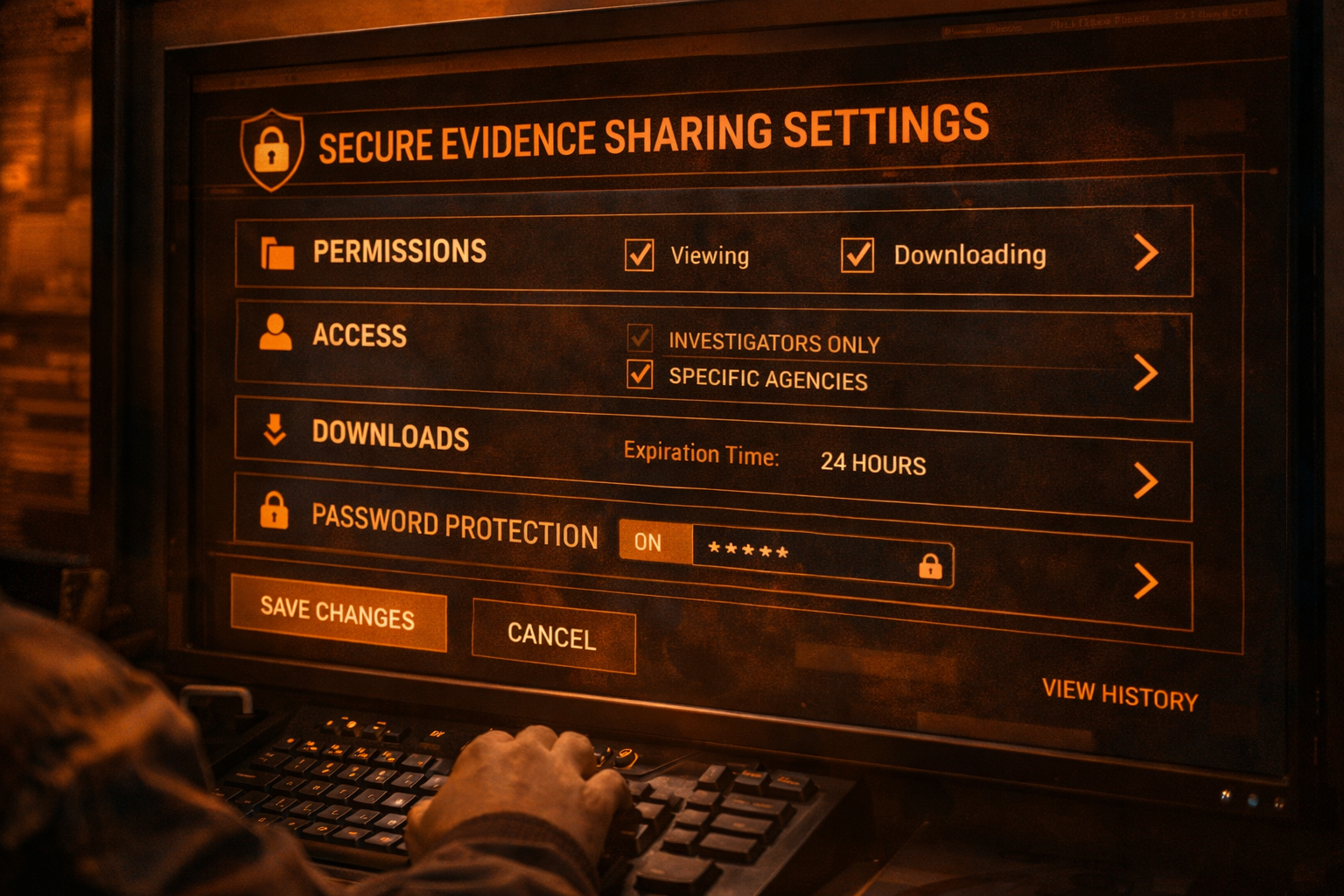
Secure sharing controls in centralized evidence review software for law enforcement
4) Platform and method-based options
Option A: A centralized evidence review capability within a Digital Evidence Management System (DEMS) that works with your existing stack
For many law enforcement agencies, the biggest challenge is not collecting or storing evidence. It’s reviewing it efficiently when that evidence lives across body-worn camera systems, CCTV platforms, RMS, and document repositories.
Replacing all of those systems is rarely realistic.
A DEMS with centralized, case-based evidence review solves this problem by integrating with existing systems and bringing all case-related evidence into a single review environment. Investigators, supervisors, and prosecutors can analyze the full case narrative without jumping between tools or duplicating work.
VIDIZMO is designed specifically for this role. As a Digital Evidence Management System, it enables centralized evidence review through capabilities such as transcription-based search, summaries, redaction, and case-level reporting—while integrating with existing RMS, CAD, and evidence capture environments.
This approach is especially effective for agencies that already have infrastructure in place but face review bottlenecks due to mixed evidence types, growing video volumes, and increasing disclosure pressure. By unifying how evidence is reviewed—without forcing agencies to abandon their operational stack—VIDIZMO helps agencies regain control.
Where it helps
- Agencies with RMS/DEMS in place but review bottlenecks
- Mixed evidence types that need to be understood together
Option B: Built-in DEMS review tools (good for storage-first workflows)
Many digital evidence management systems support end-to-end evidence handling “from beginning to end.”
Where it helps
- Ingest from common sources (BWC, CCTV, uploads)
- Basic review, organization, and sharing
Where agencies hit limits
- Review remains file-based rather than case-workspace-based
- Investigators still export clips to finish work elsewhere
- Cross-format review (video + audio + documents) may be uneven
Option C: Case management + eDiscovery-style review platforms
Some platforms blend case management with eDiscovery-style review workflows, which can be valuable for large, document-heavy investigations.
Where it helps
- Heavy review workflows (production, hearings, large case files)
Where it can be hard for police operations
- Can feel “legal ops” heavy for frontline investigators
- Implementation complexity and training burden can be real
Option D: Evidence sharing portals (best when the main pain is secure exchange)
Some tools lean heavily into secure collection and sharing across parties.
Where it helps
- Controlled external submission and distribution
- Reducing email and USB sharing
Risk to watch
- If sharing is strong but review is weak, investigators still jump between tools
5) Comparison checklist: what “good” must include (non-negotiables)
Use this checklist to compare centralized evidence review software for law enforcement:
- Supports video, audio, images, and documents in one review flow
- Immutable audit trails for access and actions
- Role-based permissions aligned with CJIS Security Policy requirements
- Secure sharing options for prosecutors and courts with visibility into access
- Policy-backed workflows (documentation and procedures matter)
6) Where VIDIZMO fits
If your biggest problem is reviewing bottlenecks, not just storage, VIDIZMO is designed to centralize evidence review across formats.
VIDIZMO’s approach allows teams to review video, audio, documents, and images in one place, then use transcription, summarization, and redaction to speed up case preparation, without forcing agencies to abandon existing systems or evidence sources.
This matters because the time drain in modern policing is not only collecting evidence. It’s understanding it, packaging it, and defending how it was handled.
7) Trust and authority signals: what makes the workflow defensible
When evidence is challenged, agencies need to show two things:
- CJIS-compliant security controls suitable for criminal justice information
- Process evidence: audit trails that show who accessed what and when
Policy and procedure guidance for digital evidence handling is not a “nice-to-have.” In many environments, it’s a requirement.
If your centralized review system cannot produce defensible audit detail, you are taking on avoidable risk.
8) Decision guidance: questions to ask internally
- How often do cases stall because evidence is spread across places and people?
- If a supervisor asks, “Who viewed this video, and who exported it?” can you answer fast?
- Are you comfortable sharing evidence externally without knowing if it was downloaded or forwarded?
- Is your biggest pain storage, or review time and defensibility?
The higher your disclosure volume and the more sensitive your footage, the more centralized review and auditability become non-negotiable.
9) Clear takeaway: the safest path forward
The safest path is not more tools.
It’s one review workflow that is centralized, controlled, and provable.
Start with a case-based review approach inside a CJIS-compliant digital evidence management system. Lock it down with role-based access controls and require audit trails for every meaningful action.
Then choose the platform option that matches your reality, built-in DEMS review, eDiscovery-style platforms, sharing portals, or a DEMS that integrates cleanly with your existing stack.
When your evidence review is centralized, your casework moves faster, and your agency keeps control when scrutiny hits.
Jump to

Drawbacks of Manual Evidence Review in Criminal Case Management

The Impact of Auto-Transcription on Evidence Review Efficiency


No Comments Yet
Let us know what you think