

By Zahra Muskan on Jan 22, 2026 6:20:45 PM, Code:
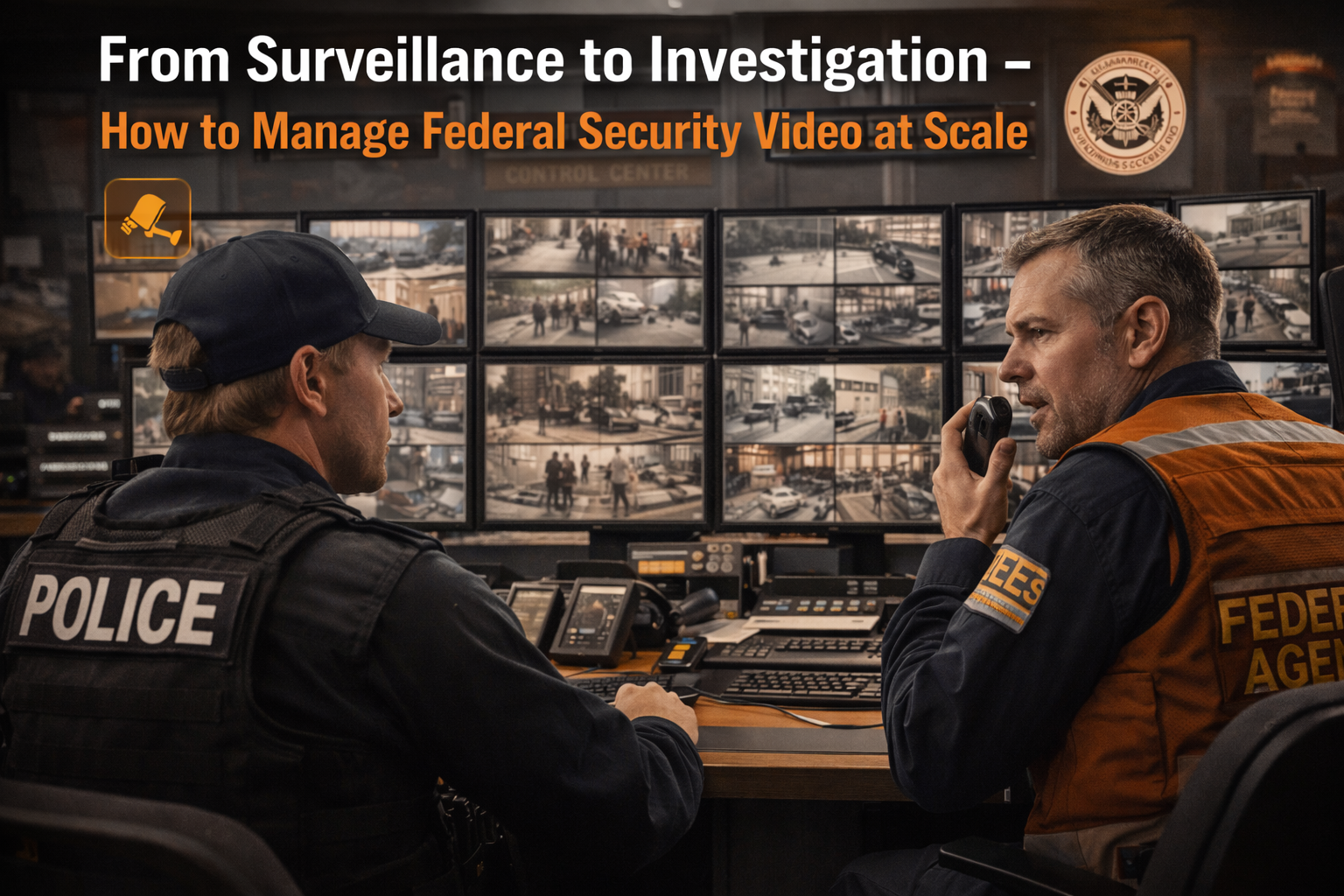
Every year, federal agencies invest heavily in surveillance infrastructure — from cameras at national landmarks and border crossings to sensors around critical infrastructure. Yet having vast amounts of video footage does not guarantee investigative success.
True federal security video management extends beyond recording: it must support rapid investigation, legal defensibility, compliance, and operational decisions at scale. This blog explains why traditional surveillance systems fall short and how agencies can evolve toward investigation-ready video intelligence.
Why Federal Surveillance Video Is Not Enough
Federal video surveillance systems were originally designed to deter, monitor, and record activity — not to support high-stakes investigations or legal proceedings. This creates three critical problems when video matters most:
- Video sprawl across systems and agencies
- Manual, time-consuming review processes
- Insufficient evidence governance and chain of custody
These challenges can delay investigations and expose agencies to compliance risks under federal evidence standards.
Federal Research & Risk Landscape: What Government Studies Reveal
1. Federal Agencies Struggle With Video Management
A National Archives report found that law enforcement agencies vary widely in how they create, manage, use, and ultimately dispose of video surveillance records, highlighting the need for standardized policies and workflows for video retention and disposition.
2. Chain of Custody Matters for Digital Evidence
Maintaining a documented chain of custody is essential for any item, including video, to be used in investigations or legal proceedings. Clear federal guidance from the Cybersecurity and Infrastructure Security Agency (CISA) emphasizes accountability and safeguards against tampering.
3. Evidence Collection & Preservation Is Complex
The National Institute of Standards and Technology (NIST) highlights that digital evidence — including video — presents unique preservation challenges that go beyond traditional physical evidence.
4. Federal Evidence Management Standards Exist
For federal law enforcement agencies such as the Department of the Interior, formal evidence management policies define how video and other evidence must be recorded, safeguarded, stored, and released.
5. Best Practices for Video Evidence Retrieval
The Bureau of Justice Assistance provides a law enforcement guide outlining best practices for securing and collecting video evidence from DVR systems.
6. Surveillance Technology Is Continuously Evolving
The Department of Homeland Security’s Video Security Systems Technology Handbook provides federal responders with guidance on evaluating and selecting video security system technologies and components.
The Core Problem: Surveillance ≠ Investigation
Surveillance video systems are optimized for:
- Recording continuous video
- Supporting live monitoring
- Basic retention for compliance
They are not optimized for:
- Rapid, cross-system investigative search
- Preserving chain of custody
- Legal defensibility
- Data normalization across sources
Without tools that treat video as investigative evidence, agencies are left manually exporting and reviewing footage — an unreliable and slow approach at federal scale.
How Traditional Approaches Break Down
Fragmented Video Sources
Federal operations often involve multiple disparate systems — legacy CCTV, cloud video storage, mobile cameras, drones, partner feeds, and more. Each has its own format and access control, making unified review difficult.
Manual Review Fails at Scale
When an incident happens, typical steps include:
- Downloading footage manually
- Scrubbing hours of video
- Exporting clips to investigators
- Sharing copies via email or removable media
This approach increases risk, reduces traceability, and wastes agency time.
Redefining Federal Video Management: A Four-Stage Model
To manage federal security video at scale, agencies need to treat video as investigative data, not just media.
Stage 1: Centralized Video Ingestion & Normalization
Rather than replacing existing surveillance systems, agencies must ingest video from multiple sources into a centralized platform that:
- Normalizes formats
- Preserves original footage
- Supports indexing and metadata enrichment
This builds a foundation for scalable search and investigation.
Stage 2: Intelligent Video Search
Time-based playback is no longer enough. Modern investigations need:
- Object detection (e.g., identifying persons or objects of interest)
- Event tagging and metadata indexing
- Motion and behavior detection
AI and machine learning research — including work from multi-agency federal initiatives — show that automated visual analytics accelerate evidence discovery across massive video datasets.
Stage 3: Separation of Surveillance vs. Investigative Access
Not all users need the same permissions. Operational monitoring and investigative access require different role controls, full audit trails, and case-level security.
This aligns with best practices for evidence handling and federal digital evidence policies.
Stage 4: Evidence-Grade Governance & Chain of Custody
Once video is flagged for investigation, it should be:
- Locked with tamper-proof controls
- Versioned with immutable history
- Shared only with authorized parties
- Traceable for audit or litigation
These capabilities are at the core of defensible digital evidence management.
What This Means for Federal Agencies
This new model must account for:
- Scalability — high volumes of video
- Cross-system visibility — centralized dashboards
- Legal defensibility — authenticated chain of custody
- Search performance — AI-driven insights
- Role-based governance — strict access control
Agencies that fail to adopt these capabilities face delays in investigations, higher labor costs, and increased compliance risk.
Real-World Context: Surveillance and Data Integration
While not federal national surveillance programs, large-scale public safety systems illustrate the value of centralized video and analytics. For example, Chicago’s Operation Virtual Shield linked thousands of cameras into a real-time monitoring network designed to detect and analyze activity across the city.
These examples highlight how integrated video and data systems improve situational awareness — but also underscore the need for robust investigative workflows.
Decision Checklist for Federal Leaders
Before selecting technology, ask:
✔ Can you locate relevant footage across all systems within minutes?
✔ Do investigative teams have searchable access to metadata?
✔ Is the chain of custody automatically recorded and tracked?
✔ Are cross-agency workflows supported without insecure sharing?
✔ Can video be defended in court or audit with integrity proofs?
If the answer is no to any — your surveillance ecosystem is not investigation-ready.
Turning the Problem Into an Investigation-Ready Solution With VIDIZMO
VIDIZMO directly addresses the gap between passive surveillance and evidence-driven investigation by enabling federal agencies to manage video as defensible digital evidence from the moment it is ingested. Designed for government-scale operations, VIDIZMO ingests video from disparate surveillance systems without disrupting existing infrastructure, normalizes formats, and preserves original footage integrity.
Built-in AI-powered search, metadata indexing, and role-based access controls allow investigators to rapidly locate relevant footage while maintaining strict separation between operational monitoring and investigative workflows.
Most critically, VIDIZMO enforces evidence-grade governance with immutable audit trails, automated chain of custody, and secure evidence sharing — aligning with federal standards for digital evidence management, legal defensibility, and compliance.
By transforming fragmented video ecosystems into a centralized, investigation-ready intelligence platform, VIDIZMO enables agencies to reduce investigation time, lower compliance risk, and confidently defend video evidence in audits, inquiries, and court proceedings.

Conclusion: Move Beyond Surveillance to Investigation
Managing federal security video at scale is not just a recording and storage challenge. It is an operational transformation that bridges surveillance, search, compliance, and legal defensibility.
Government research emphasizes the need for improved evidence management, standardized practices, and scalable technology frameworks.
By adopting centralized ingestion, intelligent search, role-based access, and evidence-grade governance, agencies can turn video from passive media into actionable investigative intelligence.
Jump to

The Role of AI Redaction in Privacy-First Security and Law Enforcement

Data Retention, Legal Holds, and Evidence Disposition in Government

No Comments Yet
Let us know what you think