

By Zahra Muskan on Jan 22, 2026 4:41:43 PM, Code:
The Real Risk of Sharing Police Videos
In Colorado last year, a judge ordered the Aurora Police Department to release all unedited body-worn camera footage from a fatal officer-involved shooting after finding the department violated state law by withholding the full video. The ruling came amid legal pressure from media outlets that sued to obtain the complete unredacted recordings, highlighting how critical footage, when only partial or edited segments are initially released, can distort public understanding and erode trust in law enforcement transparency.
This case underscores a key fear for law enforcement: the very videos meant to support accountability can become a source of legal and reputational risk if mishandled. Agencies face mounting pressure from public-records laws, litigants, and advocates to release footage in its entirety, but doing so without robust redaction can compromise privacy, reveal sensitive investigative methods, or expose bystander identities , potentially jeopardizing cases and community trust alike.
A single unredacted frame can undo an entire investigation.
Law enforcement agencies handle videos that contain faces of minors, victims, undercover officers, and private citizens. Body-worn cameras, dashcams, CCTV, interview recordings, and evidence submissions are now shared with prosecutors, defense counsel, courts, and the public.
Without proper video redaction software for law enforcement, agencies risk data leaks, legal challenges, dismissed cases, and loss of public trust.
Ask yourself:- Are you confident every copy of a shared video is fully redacted?
- Can you prove who accessed it and when?
Why Video Redaction Software Is Mandatory for Law Enforcement
Manual redaction does not scale.
Frame-by-frame blurring in basic video editors is slow and error-prone. As video volumes increase and disclosure timelines shrink, mistakes become inevitable.
Modern video redaction software for law enforcement uses AI to automatically detect and redact sensitive elements while maintaining evidence integrity. This allows agencies to respond faster to FOIA requests, court orders, and internal reviews without sacrificing accuracy.
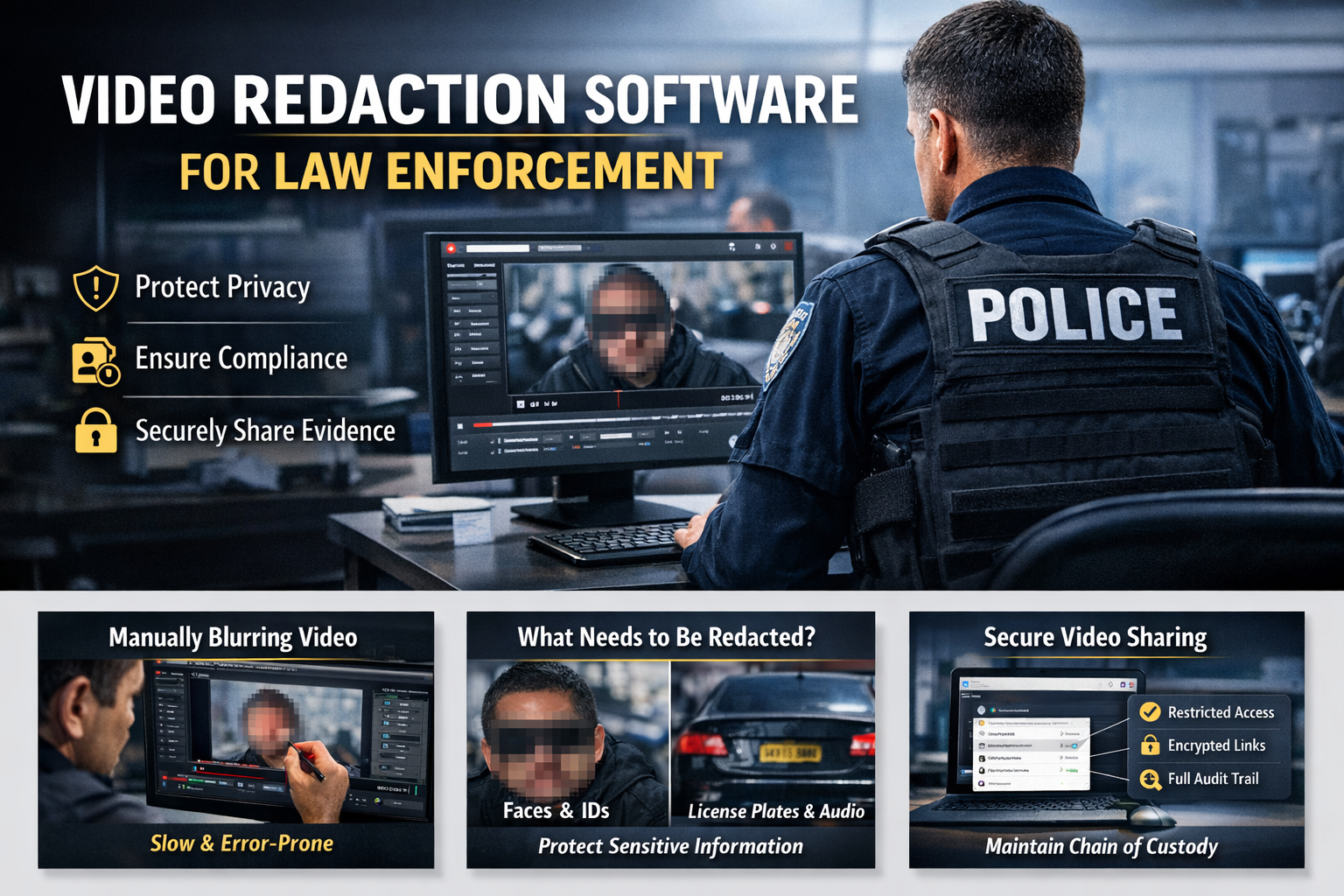
What Must Be Redacted in Law Enforcement Videos
Redaction requirements go far beyond faces.
Law enforcement videos often contain:
- Faces of bystanders and minors
- License plates and vehicle identifiers
- Police badges and IDs
- Computer screens and paperwork
- Audio with names, addresses, or medical details
Effective video redaction software for law enforcement must handle video and audio together, ensuring nothing sensitive slips through during playback.
Why Redaction Alone Is Not Enough
This is where most agencies fail.
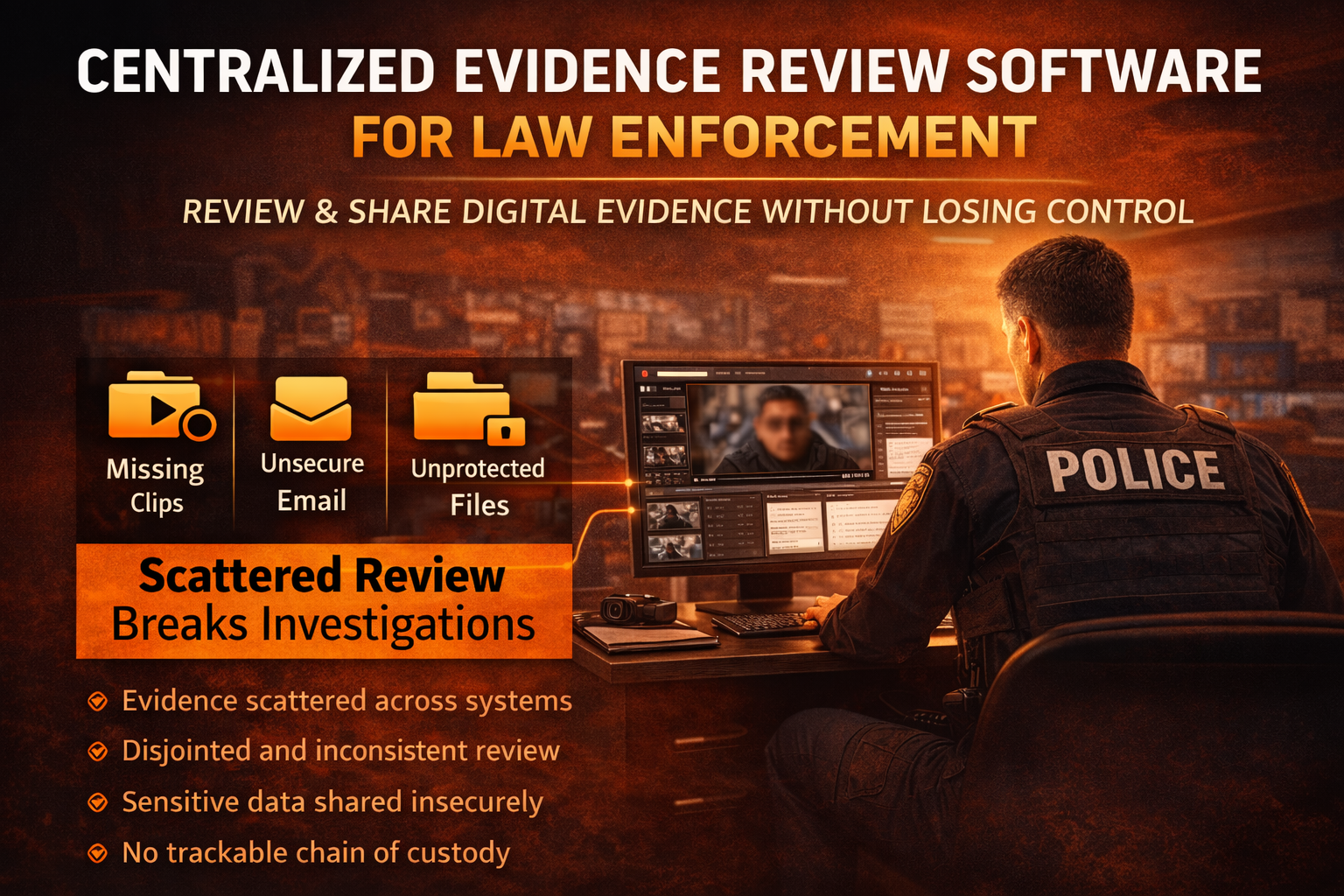
Even after redaction, videos are often shared through unsecured links, email attachments, or consumer cloud storage. That breaks the chain of custody and introduces new risks.
Secure video sharing requires:
- Encrypted storage and delivery
- Role-based access control
- Expiring links
- Full audit logs
Without these, redacted videos can still be copied, altered, or leaked.
What Secure Video Redaction Software for Law Enforcement Must Include
To truly protect evidence, a platform must offer:
- Automated face, object, and audio redaction
- Support for video, audio, images, and documents
- CJIS-aligned security controls
- Role-based access and permissions
- Tamper-proof audit trails
- Controlled external sharing
- Court-ready exports
Anything less leaves gaps that defense attorneys and auditors will find.
How VIDIZMO Supports Secure Law Enforcement Video Redaction
VIDIZMO is designed for agencies that cannot afford mistakes.
It enables law enforcement teams to redact sensitive content using AI-assisted tools while preserving the original evidence. Redacted versions are securely shared through controlled access links, ensuring only authorized viewers can access them.
VIDIZMO supports redaction across video, audio, documents, and images within a single platform. It also maintains audit logs, access controls, and evidence integrity aligned with government and security standards. Trusted organizations, including government agencies and public-sector bodies, rely on VIDIZMO to manage and share sensitive video securely.

Conclusion: Video Redaction Software for Law Enforcement Is About Trust
Video redaction software for law enforcement is not just about blurring faces. It is about protecting victims, officers, investigations, and public trust.
Agencies that combine redaction with secure sharing, access control, and auditability are better prepared for FOIA requests, court scrutiny, and public accountability.
If your current workflow ends at “blur and export,” it is time to rethink your approach.
People Also Ask
What is video redaction software for law enforcement?
Video redaction software for law enforcement removes or obscures sensitive visual and audio information from police videos before they are shared externally.
Why do police agencies need video redaction software for law enforcement workflows?
Police agencies need video redaction software for law enforcement to comply with FOIA laws, protect privacy, and prevent evidence leaks.
What information must be removed using video redaction software for law enforcement?
Faces, license plates, personal identifiers, audio mentions of names, and sensitive documents must be redacted.
Is video redaction software for law enforcement required for FOIA requests?
Yes, FOIA and public records laws often require redaction before releasing law enforcement videos.
Can video redaction software for law enforcement redact audio as well?
Advanced platforms support both video and audio redaction to prevent spoken information leaks.
How does VIDIZMO support video redaction software for law enforcement?
VIDIZMO provides AI-powered redaction, secure sharing, audit logs, and access control in one platform.
Is VIDIZMO suitable for court-ready law enforcement video redaction?
Yes, VIDIZMO maintains evidence integrity and auditability required for court and prosecutorial use.

Key Takeaways
- Video redaction software for law enforcement is essential for securely sharing confidential videos without exposing sensitive information.
- Redaction failures often happen during sharing, not editing.
- Automated redaction reduces human error and speeds up FOIA and court workflows.
- Law enforcement agencies must redact video, audio, documents, and images together.
- Secure access control and audit trails are as important as blurring faces.
- VIDIZMO provides an end-to-end platform for redaction, security, and compliance.
Jump to
Critical Role of Automated Redaction in Law Enforcement and Justice
How Police Agencies Prepares Court-Ready Redacted Video for Prosecutors

No Comments Yet
Let us know what you think