

How to Prepare Your Agency for AI Audits and Oversight When Oversight Bodies Expect Proof, Not Promises
By Zahra Muskan on Jan 22, 2026 6:00:52 PM, ref:
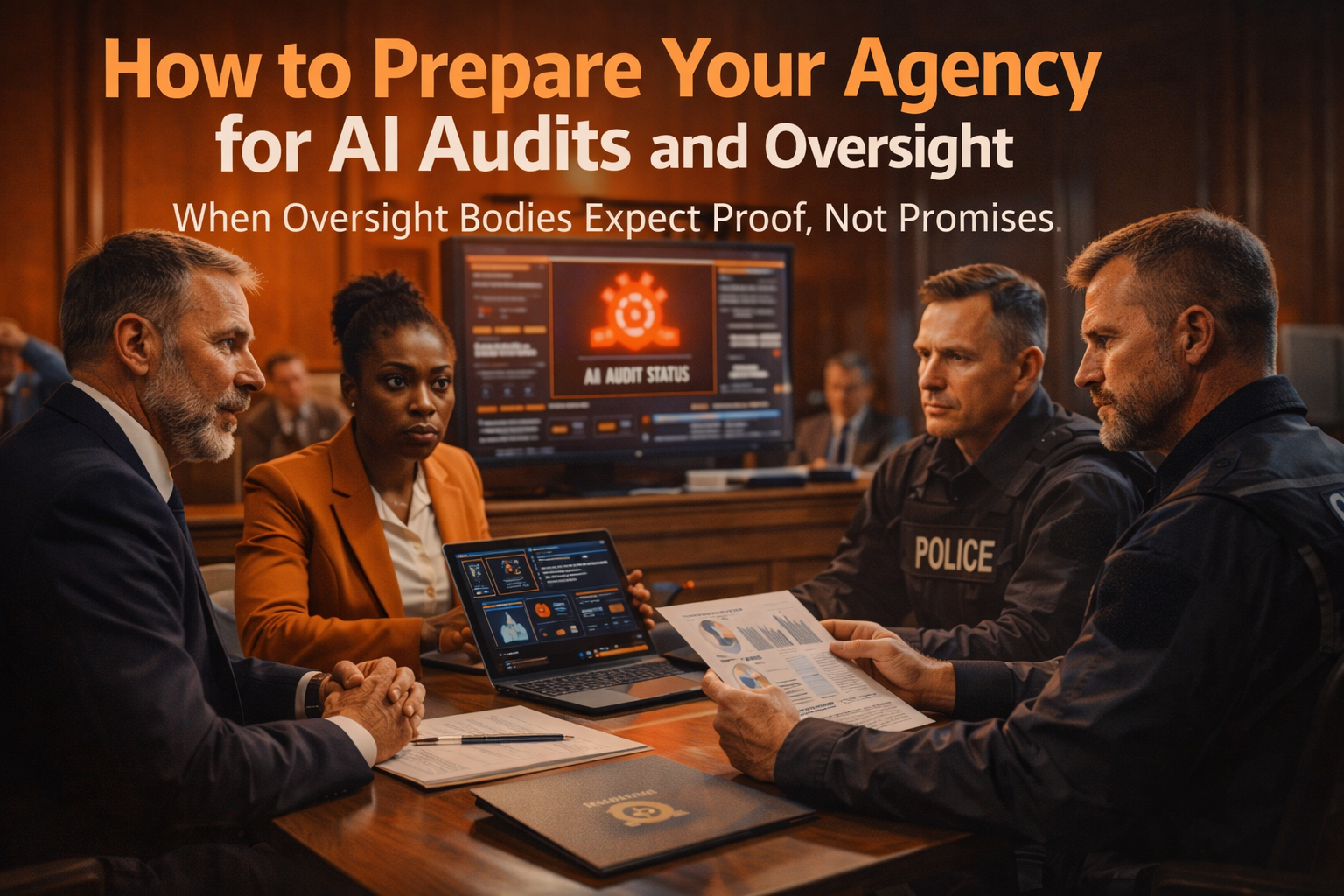
Why AI audits and oversight are becoming a direct operational risk for agencies
AI oversight is no longer theoretical for public-sector agencies. Oversight bodies, inspectors general, courts, and regulators are actively examining how agencies use AI across investigations, surveillance, evidence review, records processing, and decision-support workflows.
The risk is not that agencies are using AI. The risk is that agencies cannot prove how AI was used, who used it, what data it touched, and whether humans remained accountable.
When an agency cannot answer those questions with system-level evidence, AI itself becomes the compliance failure. This is why AI audits increasingly result in paused programs, restricted deployments, or findings that force agencies to unwind tools they already rely on.
Most agencies are discovering this problem too late, because their platforms were never designed for audit-grade AI oversight.
What AI audits and oversight actually examine inside an agency environment
An AI audit does not focus on how advanced a model is. It focuses on whether the agency can demonstrate control, traceability, and accountability across the entire AI lifecycle.
Auditors typically assess whether an agency can prove, not just state, the following:
- Where AI is used across the organization
- Which AI use cases impact investigations, enforcement, or rights
- Who is authorized to use AI and under what conditions
- What data AI systems access and how that access is restricted
- Whether AI outputs are logged, preserved, and reviewable
- How AI-related changes are approved, tracked, and monitored
Most platforms were built to produce insights, not to withstand scrutiny. That difference is where audits are won or lost.
Why most AI, analytics, and evidence platforms fail AI audits and oversight reviews
The majority of platforms agencies rely on today fail AI audits for structural reasons, not configuration issues.
Generic AI platforms prioritize speed and experimentation. SaaS AI tools optimize for usability and scale. Video and evidence systems that “add AI” usually bolt it onto architectures that were never built for accountability.
These platforms typically fail because they cannot reliably provide:
- Case-level isolation of AI activity
- Immutable, end-to-end audit trails
- Role-based restrictions on AI usage itself
- Long-term retention of AI outputs as defensible records
- Clear linkage between AI outputs and human decisions
When oversight asks for proof, agencies are left reconstructing events manually, relying on screenshots, or pointing to vendor documentation that does not reflect how AI was actually used.
That is not oversight readiness. That is operational exposure.
The core oversight problem agencies face with AI is not policy but infrastructure
Most agencies respond to AI oversight pressure by writing policies, forming committees, and referencing frameworks. Those steps are necessary, but they are not sufficient.
AI oversight fails when governance exists on paper but cannot be enforced inside systems.
True AI audit readiness requires infrastructure that automatically enforces:
- Who can access AI
- What evidence AI can be applied to
- How outputs are generated and preserved
- How every interaction is logged without user discretion
If a platform does not enforce these controls by design, no amount of policy will compensate during an audit.
How to prepare for AI audits and oversight when your systems must survive scrutiny
How agencies should treat every AI output as auditable evidence
Any AI output that influences investigations, surveillance review, case preparation, or records handling must be treated as auditable material.
This means AI outputs must be preserved with the same rigor as other sensitive digital records. They must be time-stamped, traceable, protected from tampering, and reviewable long after initial use.
Most platforms treat AI outputs as temporary or disposable. That assumption collapses the moment an audit, legal challenge, or oversight inquiry occurs.
VIDIZMO treats AI outputs as governed digital evidence by default, which is a foundational difference auditors immediately recognize.
Why centralizing AI activity is mandatory for AI oversight readiness
AI oversight becomes unmanageable when AI usage is scattered across disconnected tools, storage systems, and logs.
Auditors expect agencies to produce a coherent, centralized account of AI usage. Fragmentation creates blind spots, inconsistent records, and gaps that oversight bodies interpret as lack of control.
VIDIZMO centralizes AI-assisted activity within a single, governed environment. AI-driven discovery, analysis, redaction support, and evidence handling all operate under unified access control and audit logging.
This centralization allows agencies to respond to oversight requests without scrambling across multiple systems.
How enforcing role-based AI access prevents the most common audit failures
One of the most frequent audit findings related to AI is that agencies cannot prove AI usage was limited to authorized personnel.
Most systems restrict access to data but do not restrict who can apply AI to that data.
VIDIZMO enforces role-based permissions at the AI level. This ensures that only approved users can invoke AI capabilities, and only within approved case contexts. Every action is recorded automatically.
This directly addresses oversight concerns around unauthorized AI use, overreach, and accountability gaps.
Why automated audit logs are non-negotiable for AI oversight
AI oversight depends on detailed activity records. Auditors expect to see who used AI, when, on which evidence, and what outputs were produced.
Manual logging fails under real-world conditions. Users forget. Records are incomplete. Timelines break down.
VIDIZMO generates immutable audit logs automatically. Every AI interaction, evidence access event, and user action is captured without relying on user behavior.
This removes ambiguity and creates a defensible oversight trail.
How preserving AI outputs as records protects agencies years later
AI audits do not end when a case closes. Oversight inquiries often occur months or years after AI-assisted decisions were made.
Agencies must be able to reproduce what AI produced at the time, understand how it influenced human decisions, and demonstrate that outputs were not altered.
VIDIZMO preserves AI outputs alongside the underlying evidence, maintaining version history, timestamps, and access records. This ensures agencies can defend past actions with confidence.
Most AI platforms cannot support this requirement at all.
Why VIDIZMO is structurally designed to survive AI audits and oversight
VIDIZMO was built for environments where scrutiny is expected, not optional. Its architecture reflects the realities of law enforcement, justice, regulatory, and public-sector oversight.
Unlike platforms that retrofit governance after the fact, VIDIZMO embeds governance into:
- Access control
- Evidence handling
- AI-assisted workflows
- Audit logging
- Retention and compliance
This makes VIDIZMO audit-ready by design, not by configuration.
How VIDIZMO succeeds where other platforms collapse under AI oversight
VIDIZMO enables agencies to demonstrate:
- Centralized, controlled AI usage
- Clear accountability for every AI-assisted action
- Immutable audit trails suitable for oversight review
- Case-level isolation and permission enforcement
- Long-term preservation of AI outputs as records
These capabilities align directly with what AI audits actually test. They are not optional features. They are structural requirements.
Why AI governance frameworks alone cannot protect agencies during audits
Frameworks like NIST AI RMF or ISO/IEC 42001 define what responsible AI governance should look like. They do not enforce it.
Auditors assume agencies have systems capable of operationalizing these frameworks. Without a platform like VIDIZMO, frameworks remain aspirational documents rather than provable controls.
VIDIZMO is what turns governance intent into audit-survivable reality.
How agency leaders should evaluate their AI audit readiness today
Agency leadership should ask direct, uncomfortable questions:
- Can we produce AI usage logs today without manual reconstruction?
- Can we prove who accessed AI outputs for a specific case?
- Are AI-assisted decisions traceable and reviewable years later?
- Do our systems enforce AI access restrictions by role and case?
- Would our vendors survive independent oversight scrutiny?
If the answer is unclear, the risk is real.
The safest long-term approach to AI audits and oversight in regulated environments
Agencies that pass AI audits will not be the ones with the most advanced AI models. They will be the ones with infrastructure that proves accountability under pressure.
AI oversight is about surviving scrutiny, not showcasing innovation.
VIDIZMO was built for that reality.
Jump to
You May Also Like
These Related Stories
The Role of AI Redaction in Privacy-First Security and Law Enforcement

Secure Digital Evidence Disclosure: Redaction, Access & Audit Trails


No Comments Yet
Let us know what you think