
By Ali Rind on February 26, 2026

Body-worn cameras (BWCs) have become standard equipment in law enforcement agencies across the United States. But while the operational impact of body worn cameras on police departments continues to grow, managing the body worn camera evidence they generate is anything but straightforward. Agencies face mounting pressure from storage costs, compliance mandates, staffing constraints, and the sheer volume of video pouring in every shift. If your department is working through a broader evidence management strategy, BWC footage is likely the single largest contributor to your digital evidence backlog.
This guide breaks down the most significant challenges agencies face when managing body worn camera evidence and outlines practical approaches to solving each one, drawing on findings from the US Department of Justice's Office of Justice Programs (OJP) research into BWC digital evidence management strategies.
The Scale of the BWC Evidence Problem
A single officer wearing a body camera for an eight-hour shift can generate 10 to 15 GB of video data per day. Multiply that across a department of 100 officers, and you are looking at over a terabyte of new evidence every week. For larger agencies, the numbers grow exponentially.
This is not just a storage problem. Every minute of that footage must be:
- Ingested into a secure system with a documented chain of custody
- Tagged and categorized by case, officer, date, and incident type
- Retained according to state and federal retention schedules
- Located and retrieved when investigators, prosecutors, or FOIA officers need it
- Redacted before any public release to protect personally identifiable information (PII)
- Purged when retention periods expire, with documented proof of disposition
When agencies rely on manual processes, USB drives, or proprietary vendor portals that only work with one camera brand, these requirements quickly overwhelm available resources.
Challenge 1: Cost, Staffing, and Resource Constraints
According to OJP research, 28% of agencies cite cost, staffing, and resource limitations as their top body worn camera evidence management challenge. The expense goes far beyond the cameras themselves. Agencies must budget for:
- Cloud or on-premises storage infrastructure
- Software licensing for evidence management platforms
- Dedicated staff to manage uploads, tagging, and retrieval
- Training for officers and civilian personnel
- Ongoing maintenance and vendor support contracts
Many departments, particularly small and mid-sized agencies, lack the IT staff to maintain complex evidence infrastructure. Evidence custodians often manage BWC footage alongside their existing caseload, creating bottlenecks that delay investigations. Understanding how to manage digital evidence after body-worn camera adoption is the first step toward building a workflow that scales with your department's needs.
How to Address It
Automation is the most effective lever for reducing the resource burden. A Digital Evidence Management System (DEMS) that automates ingestion through watch folders, monitored directories that automatically upload footage when files are added, eliminates manual upload steps. Automated retention policies handle evidence lifecycle management without requiring staff to track expiration dates manually. AI-powered transcription and tagging reduce the hours spent reviewing and categorizing footage. The goal is to shift staff time from administrative tasks to investigative work.
Challenge 2: Storage and Infrastructure Management
OJP findings show that 25% of agencies identify storage and infrastructure as a primary challenge. Body worn camera evidence demands significant and growing storage capacity, and agencies face a difficult decision: invest in on-premises infrastructure with large capital expenditure, or move to cloud storage with recurring operational costs.
Neither option is without tradeoffs. On-premises storage gives agencies full data sovereignty but requires IT staff to maintain hardware, manage capacity planning, and handle disaster recovery. Cloud storage reduces infrastructure overhead but raises questions about CJIS-compliant management and data residency.
How to Address It
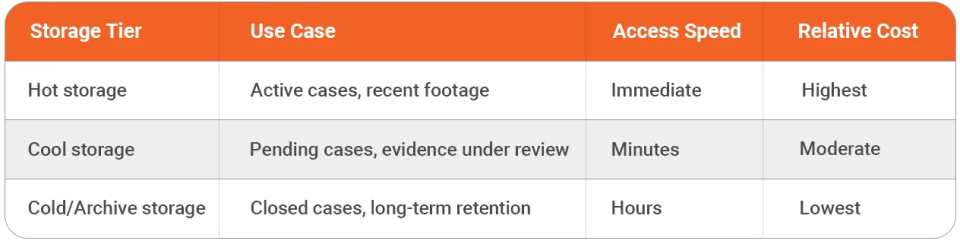
The most effective approach is a tiered storage strategy that matches storage cost to evidence access frequency:
Tiered Storage Strategy for BWC Evidence
A platform that supports flexible deployment, whether SaaS, government cloud, on-premises, or hybrid, lets agencies choose the model that fits their budget, compliance requirements, and existing infrastructure. Agencies running on-premises evidence management can keep sensitive evidence local while archiving older footage to lower-cost cloud tiers.
Challenge 3: Video Redaction for Public Records Requests
OJP research identifies redaction as a challenge for 14% of agencies, and this percentage understates the operational impact. A single FOIA request involving BWC footage can require hours of manual frame-by-frame redaction to obscure faces, license plates, addresses, and other PII before public release.
The volume of public records requests continues to increase as communities demand greater transparency from law enforcement. Agencies that lack efficient redaction tools face a difficult choice: delay responses and risk statutory deadline violations, or rush redactions and risk exposing protected information.
How to Address It
AI-powered redaction dramatically reduces the time required to prepare body worn camera evidence for public release. Modern redaction capabilities can automatically detect and redact faces, license plates, and other identifiable objects across video footage, reducing what was once hours of manual work to minutes of review and confirmation.
The key is integration between the evidence management platform and the redaction tool. When redaction is built into the same system that stores the evidence, staff avoid the time-consuming process of exporting footage, redacting in a separate application, and re-importing the redacted version. The original evidence remains untouched with its chain of custody intact, while the redacted copy is generated as a new asset with its own audit trail.
Challenge 4: Multi-Vendor Camera Environments
Most agencies do not use a single BWC vendor. Departments may have Axon cameras for patrol officers, Motorola devices for specialized units, and legacy cameras from previous procurement cycles. Each vendor typically offers its own proprietary evidence management portal, creating data silos that fragment evidence across disconnected systems.
This fragmentation complicates investigations that involve footage from multiple officers using different camera brands. Investigators must log into separate systems, use different search interfaces, and manually correlate footage by timestamp.
How to Address It
A vendor-agnostic DEMS eliminates camera brand lock-in by ingesting body worn camera evidence from any manufacturer into a single, centralized repository. Automated ingestion through watch folders or direct API connections means footage flows into the same system regardless of the camera that captured it.
This approach delivers several advantages:
- Unified search across all BWC footage, regardless of source
- Consistent chain of custody documentation for all evidence
- Freedom to switch camera vendors without migrating evidence platforms
- Simplified training: staff learn one system, not three or four
Challenge 5: Finding Critical Footage in Thousands of Hours
Investigators regularly need to locate a specific moment within thousands of hours of body worn camera evidence. Traditional approaches rely on manual review, where an investigator watches footage at normal or slightly accelerated speed, hoping to spot the relevant segment. This is slow, error-prone, and does not scale.
Even with basic timestamp and metadata search, finding the right 30 seconds across multiple officers' footage from the same incident can take hours.
How to Address It
AI-powered search transforms evidence retrieval. Rather than scrubbing through video manually, investigators can search across transcripts, spoken words, detected objects, faces, and AI-generated tags to locate relevant footage in seconds.
Capabilities that matter most for BWC evidence retrieval include:
- Speech-to-text transcription in 82 languages, making spoken content searchable
- Object detection for faces, vehicles, license plates, weapons, and other objects of interest
- Speaker diarization to distinguish between speakers in recordings
- Summarization to extract key points from lengthy footage without watching the full recording
These capabilities turn passive video archives into actively searchable intelligence.
Challenge 6: Synchronized Multi-Officer Incident Review
When multiple officers respond to an incident, each officer's body camera captures a different perspective. Reviewing these recordings individually makes it difficult to construct a complete picture of events. Investigators must manually sync footage by timestamp and switch between video players.
How to Address It
Multi-stream mosaic viewing solves this by displaying multiple camera angles in a single synchronized frame. Investigators can view all officers' perspectives simultaneously, scrubbing through the timeline to see what each officer saw at any given moment. This is particularly valuable for use-of-force reviews, major incident investigations, and courtroom presentations where a comprehensive view of events strengthens the evidentiary record.
Challenge 7: Maintaining Chain of Custody at Scale
Every piece of body worn camera evidence must maintain an unbroken chain of custody from the moment it is captured to its presentation in court or eventual disposition. At scale, maintaining this chain across thousands of evidence items, multiple users, and various sharing events becomes increasingly difficult.
Manual chain-of-custody tracking through spreadsheets or paper logs introduces the risk of gaps that can compromise evidence admissibility.
How to Address It
A purpose-built DEMS maintains chain of custody automatically by logging every interaction with evidence: uploads, views, downloads, shares, edits, and deletions. Each log entry captures the user identity, IP address, timestamp, and event details. SHA-256 hash-based tamper detection verifies that evidence has not been altered since ingestion, and WORM-enabled storage ensures audit logs themselves cannot be modified.
Exportable chain-of-custody reports in PDF and CSV formats provide the documentation courts require to establish evidence integrity and admissibility.
Best Practices for BWC Evidence Management
Based on the challenges above, agencies should prioritize these practices:
- Automate ingestion: Use watch folders or direct integrations to eliminate manual uploads
- Implement tiered storage: Match storage costs to evidence access patterns
- Adopt AI for search and redaction: Reduce manual review hours and accelerate FOIA compliance
- Choose vendor-agnostic platforms: Avoid camera brand lock-in by centralizing all BWC evidence
- Enforce automated retention policies: Configure rules for archival, legal hold, and disposition to reduce compliance risk
- Establish role-based access controls: Ensure only authorized personnel can view, share, or modify evidence
- Train staff continuously: Technology only works if the people using it understand proper evidence handling workflows
How VIDIZMO DEMS Addresses BWC Evidence Challenges
VIDIZMO DEMS manages the full BWC evidence lifecycle, from automated ingestion to final disposition, across body cams, dash cams, CCTV, drones, and mobile devices in a single CJIS-compliant repository.
Key capabilities include Watch Folder automation for hands-free ingestion from BWC docking stations, AI-powered search across transcripts and detected objects, and AI-driven redaction for faces, license plates, and PII. Multi-stream mosaic view lets investigators review multiple officers' footage simultaneously, while configurable retention policies automate archival, legal hold, and disposition.
The platform supports 255+ formats and flexible deployment across SaaS, government cloud, on-premises, or hybrid environments, so agencies avoid replacing existing camera hardware. SHA-256 tamper detection, WORM-enabled storage, and RBAC with SSO and MFA protect evidence integrity at every stage. VIDIZMO DEMS is ISO 27001:2022 certified and supports CJIS-compliant deployments on Azure Government Cloud.
See how VIDIZMO Digital Evidence Management System solves your agency's BWC evidence challenges: request a demo tailored to your needs.

Key Takeaways
-
BWC footage is your biggest digital evidence challenge. A 100-officer department generates over a terabyte of video weekly. Without the right system, storage costs, compliance requirements, and manual workflows quickly overwhelm staff and budgets.
-
The top three agency pain points are cost, storage, and redaction. According to OJP research, 28% of agencies struggle with resource constraints, 25% with storage infrastructure, and 14% with video redaction for public records requests.
-
Automation and AI are the most effective solutions. Watch folder ingestion, AI-powered search, automated redaction, and configurable retention policies dramatically reduce the manual workload on evidence custodians and investigators.
-
Vendor lock-in makes evidence management harder. Most agencies run multiple camera brands across disconnected portals. A vendor-agnostic DEMS centralizes all footage in one searchable, auditable repository regardless of camera manufacturer.
-
Chain of custody cannot be an afterthought. At scale, manual tracking breaks down. A purpose-built DEMS automatically logs every interaction with evidence, supports SHA-256 tamper detection, and generates court-ready chain-of-custody reports to protect admissibility.
About the Author

Jump to
.webp)
The Operational Impact of Body Worn Cameras on Police Departments

Top 5 Digital Evidence Management Software for Law Enforcement (2026)


No Comments Yet
Let us know what you think