
By Ali Rind on June 8, 2026
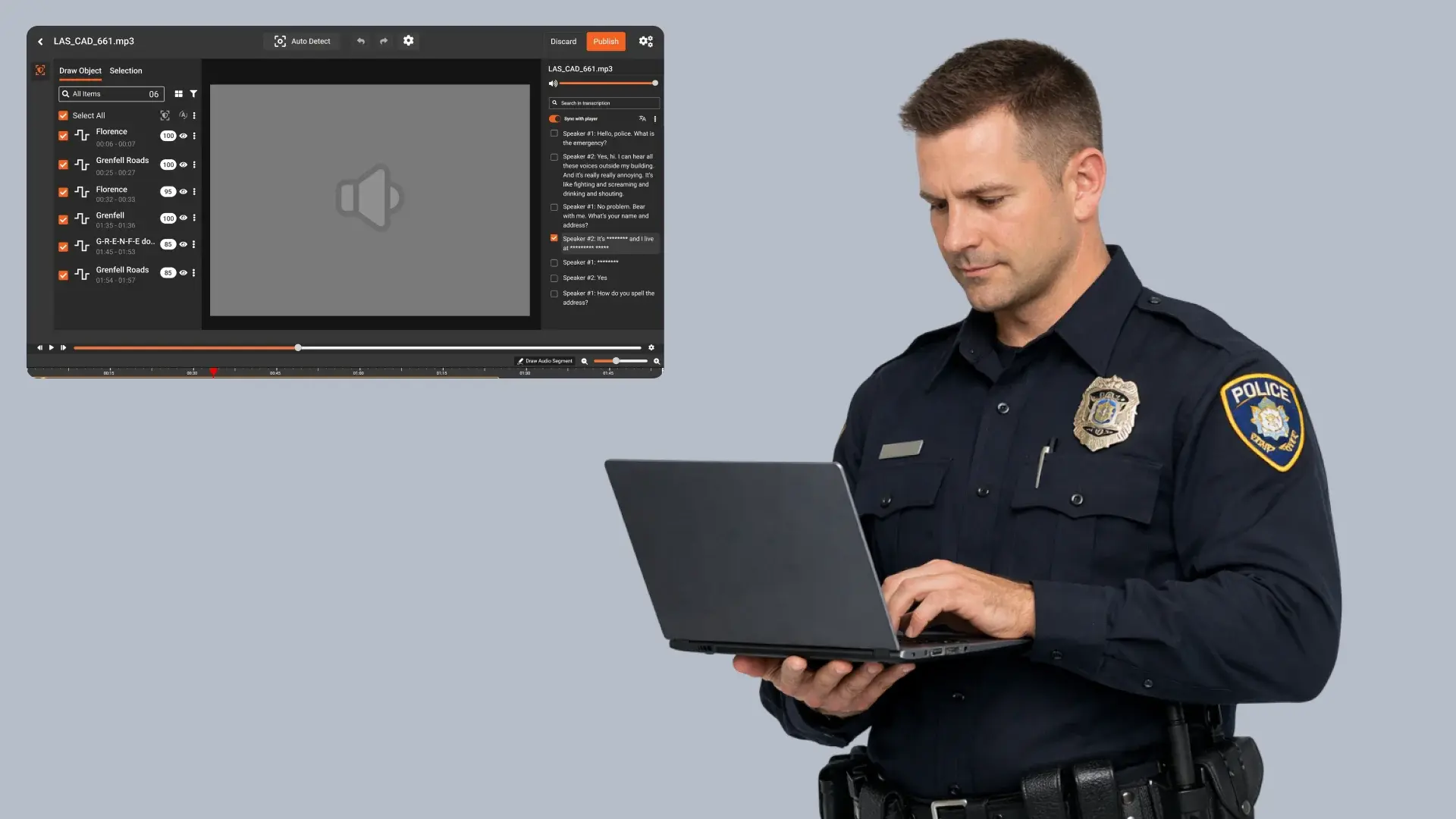
Audio redaction is the process of finding and removing spoken personal information from a recording, such as a victim's name, a juvenile's identity, a Social Security number, or a home address, before evidence is shared or released. It is harder than blurring a face because the sensitive detail is not a visible object you can track frame by frame. It is a spoken word buried in conversation, and you only know it is sensitive once you understand what was said.
That gap is where most agencies are exposed. Body-worn camera programs and rising public records demand have pushed more footage out the door, and most redaction effort still goes to the picture. Faces get blurred, license plates get pixelated, the video looks clean, and the file ships. But a victim's full name and address spoken clearly on the audio track is just as much a disclosure as showing their face, and it is far easier to miss.
Key takeaways
- Audio redaction removes spoken PII, not visible objects, so it depends on understanding language rather than tracking pixels.
- Missed spoken PII is harder to catch than a missed blur and more damaging once released, with CJIS and FOIA exposure attached.
- Manual review by listening and muting timestamps does not hold up as evidence volumes grow.
- Audio redaction belongs inside the system that manages the evidence, where chain of custody and audit logging already live.
- Transcript-driven review is what makes spoken PII findable and removable at scale.
Why redacting audio is harder than redacting video
Visual redaction is object-based. A face or a license plate is a thing that exists in the frame. Software can detect it, track it across the clip, and obscure it consistently. That work is not trivial, but it is structured, and a reviewer can see at a glance whether it worked.
Audio redaction is context-based, and context is messy. To remove spoken PII reliably, a system or a reviewer has to convert speech to text accurately, tell speakers apart, recognize that a string of words is actually a name or an address, and do all of that through accents, slang, background noise, crosstalk, and more than one language. A name spoken once at normal volume in a noisy transport van is easy to lose.
The rules are not uniform either. A suspect's name might be removed from a public release but kept when an officer uses it inside a case narrative, depending on the case type, the jurisdiction, and which FOIA exemption applies. Audio redaction is not "find a word and mute it." It is a judgment about what the words mean and what policy says to do with them.
How audio redaction actually works
In practice, removing spoken PII from a recording follows a few steps, and each one matters for accuracy.
First, the audio is transcribed into text. A searchable transcript turns hours of listening into something a reviewer can scan, search, and act on. Second, the system flags likely sensitive content, names, phone numbers, addresses, and ID-number patterns, so a reviewer is confirming candidates rather than hunting from scratch. Third, speaker identification separates who said what, which keeps the reviewer from applying the wrong rule to the wrong voice during a fast review. Fourth, in multilingual recordings, transcription has to handle more than one language and code-switching, because anything the system cannot transcribe is something it cannot help you redact.
The redaction itself is then done from the transcript. Instead of scrubbing a waveform and guessing at timestamps, a reviewer marks the sensitive text and the system mutes the matching audio, which is then validated against the playback. The transcript is the map. The audio is the territory. Working from the map is what makes the job repeatable.
The compliance and FOIA risk of missed spoken PII
Public records and FOIA requests increasingly include body camera footage, and that footage carries audio. When a spoken identifier slips through, the consequences are concrete: a victim or juvenile identity disclosed, an address or phone number exposed, complaints or litigation, and the loss of public trust that follows an avoidable privacy breach.
Visual redaction does nothing to prevent any of this. Blurring a victim's face does not protect them if their name and street address are spoken plainly thirty seconds later. This is why audio redaction has become part of basic release readiness rather than an optional extra, and why a missed mute can carry the same CJIS and legal weight as any other improper disclosure.
Why manual audio redaction breaks down at scale
Plenty of agencies still handle audio by hand, especially when their tools were built for the picture. The workflow is familiar: listen to the recording, note each sensitive moment, mark the timestamp, mute the segment, then listen again to check. For a two-minute clip, that is fine.
Now picture a four-hour body camera release where a victim's name comes up several times, a juvenile is named during an interview, and a suspect's address is spoken once during transport. Every instance has to be located precisely and muted without breaking the evidentiary record, and missing one is a privacy violation.
Multiply that across a backlog of cases and a steady stream of records requests, and the problem is no longer about how careful the reviewer is. It is about whether listening in real time can keep up with how fast evidence accumulates. It cannot, and fatigue makes the late hours the riskiest ones. The same pressure is pushing agencies toward automated redaction in law enforcement more broadly, extending to faces, plates, and documents the logic that already applies to audio.
Where audio redaction should happen
Because audio redaction touches the evidentiary record, where it happens matters as much as how well it works. Done outside the system that holds the evidence, redaction creates fragmented copies, version confusion, and gaps in the audit trail, exactly the conditions that can get evidence challenged in court.
Inside a Digital Evidence Management System (DEMS), the same controls that govern the rest of the evidence apply to redaction too. The original file is preserved while a redacted version is generated separately. Every redaction action is logged for audit. Access stays governed by role and chain of custody, and the redacted file moves through the same secure evidence sharing used for prosecutors and FOIA responses. Reviewing the audio, the transcript, and the source evidence in one place is also what reduces the odds of a missed identifier, because nothing has to be exported and reassembled.
This is the model behind the VIDIZMO Digital Evidence Management System, where transcription, transcript-linked redaction, and audit logging are part of the evidence workflow rather than a separate editing step. Agencies under heavy release volume sometimes run redaction as a dedicated operation instead, with its own staffing and review procedures. Neither model is universally correct. The right one depends on an agency's volume, team structure, and compliance requirements.
To see how integrated audio redaction works within a secure, compliance-ready platform, explore VIDIZMO Digital Evidence Management System and its built-in evidence review and redaction capabilities.

The bottom line
Audio is where the hardest spoken PII hides, and it is the part of redaction most likely to be skipped. As body camera programs grow and records requests pile up, treating audio as a side task done in an external editor is how identifiers slip into public releases. Building audio redaction into the evidence lifecycle, anchored to transcripts and a full audit trail, is what keeps releases both fast and defensible.
About the Author

Jump to

The Complete FOIA Evidence Preparation Workflow: From Request to Release

The Complete Guide to FOIA-Compliant Digital Evidence Management


No Comments Yet
Let us know what you think