
By Ali Rind on February 17, 2026

Video evidence plays a central role in modern law enforcement investigations. Agencies routinely manage large digital recordings that must be securely stored, reviewed, shared, and ultimately presented in court. Many of these files, particularly legacy dashcam footage and surveillance exports, are delivered in AVI format and can span several hours.
In most cases, however, the entire recording is not needed. An investigation may hinge on a brief interaction, a specific exchange, or a clearly defined segment within a much longer file. Operationally, the goal is straightforward: isolate the relevant portion of the footage.
Legally, the stakes are much higher.
Trimming video evidence is not merely a technical action. It affects chain of custody, metadata preservation, audit logging, and overall courtroom defensibility. If the original file is altered, overwritten, or exported improperly, the integrity of the evidence may be challenged.
For agencies handling large AVI video evidence files, the core issue is not whether footage can be trimmed, but whether it can be trimmed securely, traceably, and in a way that preserves evidentiary integrity. This is where structured digital evidence management becomes essential.
The Legal Consequences of Improperly Trimming Video Evidence
Video evidence is not ordinary media. It is a legal asset that must remain authentic, traceable, and defensible from collection to courtroom presentation.
Every evidence file must:
- Be preserved in its original, unaltered form
- Retain critical metadata such as timestamps and device information
- Maintain a documented chain of custody
- Log every access, edit, and export
This level of documentation requires a system that provides built in audit trails for digital evidence.
When AVI video evidence is trimmed using generic editing software, significant risks emerge. The original file may be modified or overwritten. Metadata can be altered during export. Most consumer tools provide no audit trail showing who created the clip, when it was generated, or how it relates to the source file.
In court, the issue is not only whether tampering occurred. The issue is whether the agency can prove that proper procedures were followed. Weak documentation or uncontrolled editing creates room for doubt, and doubt can undermine admissibility.
Trimming video evidence is therefore not just a technical task. It is a legally sensitive action that must be handled within a controlled and accountable system.
The Specific Challenge with AVI Video Evidence
AVI, short for Audio Video Interleave, is still widely used in older dashcam systems and surveillance exports. These files are often large and difficult to manage.
Agencies commonly face issues such as:
- Large file sizes that slow uploads and sharing
- Compatibility problems across systems
- Difficulty extracting short clips without reprocessing the entire file
- Lack of native playback support without specific codecs
An investigator may need only three minutes from a ninety minute AVI recording. Without the right system, extracting that segment safely becomes complicated.
Real World Scenario: Trimming Video Evidence in a Criminal Case
A municipal police department uploads a two hour dashcam AVI file following a DUI arrest. The prosecutor only needs a four minute segment covering the traffic stop, field sobriety test, and arrest.
Operationally, the task seems simple. Legally, it requires precision.
The department must:
- Preserve the original two hour file exactly as received
- Create a four minute derivative clip without altering the source
- Share the clip through a secure evidence sharing portal that tracks access and downloads.
- Maintain a complete audit trail of every action taken
If the file is trimmed using standard video editing software, the agency may not be able to demonstrate that:
- The original recording remained unchanged
- Metadata and timestamps were preserved
- The clip was generated directly from the authentic source file
- No unauthorized edits or exports occurred
In court, the inability to clearly document these steps can create procedural doubt. Even without evidence of tampering, gaps in handling controls can expose the case to unnecessary legal challenge.
Best Practices for Trimming Video Evidence Safely
Trimming video evidence must take place within a controlled and accountable workflow. The objective is not simply to shorten a recording, but to preserve evidentiary integrity at every step.
The original file should always remain secured and unaltered. In many cases, agencies must also redact sensitive information from video evidence before sharing externally., ensuring the source recording is never modified or replaced.
A defensible trimming process should ensure:
- The original recording remains intact and read only
- The clip is generated as a separate, traceable derivative
- Metadata and timestamps are preserved
- File integrity markers remain verifiable
- Every access, edit, and export is logged
Comprehensive audit logs establish a clear chain of custody, documenting who handled the evidence and when. Access controls further limit editing and export permissions to authorized personnel only.
When these safeguards are in place, trimming becomes part of a secure digital evidence management workflow rather than a procedural risk.
Why Generic Video Editing Tools Fall Short
Consumer video editing tools are designed for media production, not legal defensibility.
They do not provide:
- Chain of custody documentation
- Secure audit trails
- Evidence locking
- Controlled access management
- CJIS aligned security controls
While they may allow basic cutting and exporting, they offer no protection against procedural challenges.
For law enforcement, that gap is critical.
How a Digital Evidence Management System Solves the Problem
The VIDIZMO Digital Evidence Management System is built specifically for law enforcement evidence workflows, not general video editing.
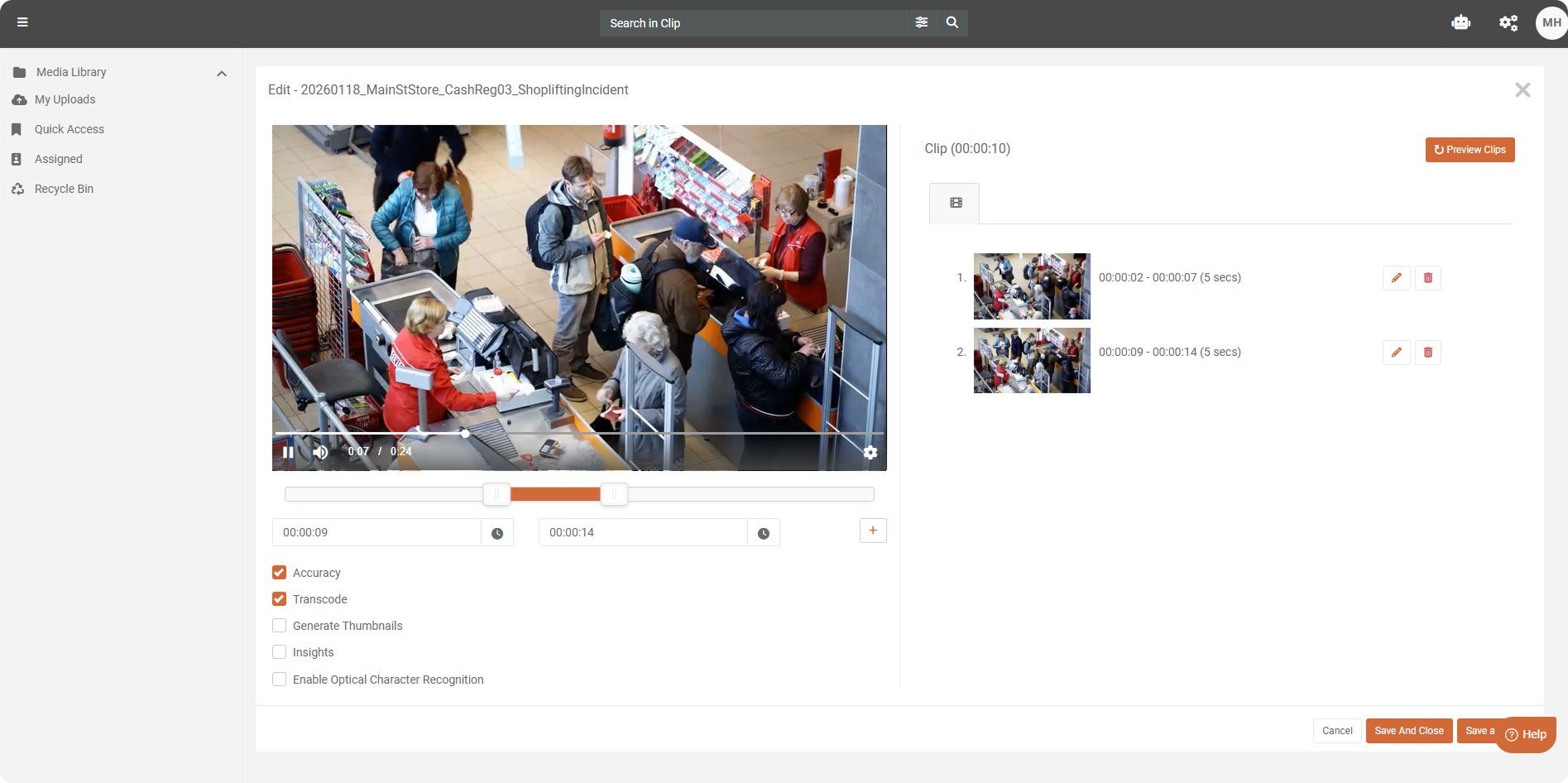
Instead of trimming footage in uncontrolled environments, agencies can manage video evidence within a secure, traceable system that protects integrity and chain of custody.
With VIDIZMO Digital Evidence Management System, agencies can:
- Trim or cut specific segments from lengthy recordings
- Generate derivative clips without altering the original file
- Preserve metadata, timestamps, and file integrity
- Automatically log who created, viewed, or exported a clip
- Share trimmed evidence securely with prosecutors or authorized personnel
In a criminal case, this means the original recording remains untouched while relevant clips are generated and shared within a fully documented workflow. Every interaction is logged, reinforcing admissibility and courtroom defensibility.
Protect your evidence. See how VIDIZMO Digital Evidence Management System enables secure and defensible video trimming.

Key Takeaways
- Trimming video evidence is a legally sensitive action, not just a technical edit.
- The original recording must always remain unaltered and preserved.
- Chain of custody documentation is essential for courtroom defensibility.
- Metadata, timestamps, and file integrity markers must be maintained.
- Generic video editing tools lack audit trails and evidence controls.
- A Digital Evidence Management System enables secure, traceable, and compliant video trimming.
- Proper evidence handling reduces legal risk and protects admissibility in court.
Secure Video Trimming Is a Legal Responsibility, Not a Technical Task
Trimming video evidence is not simply about shortening a file. It directly impacts authenticity, chain of custody, and courtroom admissibility.
Every agency handling digital evidence must ensure that:
- Original recordings remain unaltered and preserved
- Every trim, export, and access is fully documented
- Metadata and file integrity are maintained
- Evidence is shared through secure, controlled channels
When these safeguards are missing, even routine edits can introduce legal risk.
A structured Digital Evidence Management approach transforms video trimming from a procedural vulnerability into a controlled, defensible workflow. Agencies relying on generic editing tools should evaluate whether their current process can withstand legal scrutiny.
About the Author

Jump to

How Police Agencies Prepares Court-Ready Redacted Video for Prosecutors

CCTV Footage as Legal Evidence: Management, Search, and Admissibility
.webp)

No Comments Yet
Let us know what you think