
By Ali Rind on February 26, 2026

Defense and intelligence agencies operate under conditions that most civilian law enforcement organizations never encounter. Investigations span multiple classification levels, involve evidence collected across global theaters, and require coordination between agencies with fundamentally different security postures. Managing digital evidence in this environment demands more than a standard evidence management platform. It requires infrastructure that meets defense-grade security standards while keeping investigators focused on their mission rather than on administrative overhead.
For agencies evaluating how to manage digital evidence across intelligence and defense-linked investigations, the criteria extend well beyond basic storage and retrieval. Classification handling, air-gapped deployment options, and compliance with frameworks like NIST 800-53, IL4/IL5, and FedRAMP High are not optional; they are baseline requirements. This guide examines what defense agencies should prioritize when selecting a Digital Evidence Management System (DEMS), and where current approaches tend to fall short.
Why Defense Investigations Create Unique Evidence Challenges
Defense-linked investigations generate evidence that differs from standard law enforcement cases in several critical ways.
Multi-source, multi-classification evidence. A single investigation may involve body-worn camera footage from military police, drone surveillance with embedded KLV sensor data, intercepted communications, satellite imagery, and interview room recordings. Each source may carry different classification markings and handling requirements. Traditional evidence management systems designed for a single agency or jurisdiction struggle to accommodate this complexity.
Cross-agency coordination with strict compartmentalization. Intelligence investigations often involve coordination between the Department of Defense (DoD), the intelligence community, federal law enforcement, and allied international partners. Evidence must be shared selectively. Specific assets may be accessible to one team while completely invisible to another. This requires more than folder-level permissions; it demands architecturally segregated environments with autonomous security policies.
Extended evidence lifecycles. Unlike routine criminal cases where evidence may be dispositioned within years, defense and intelligence evidence can carry retention obligations that span decades. National security investigations, war crimes documentation, and counter-terrorism cases require evidence to remain accessible, integrity-verified, and properly cataloged long after the original investigation concludes.
Operational security constraints. Some defense environments operate on classified networks with no internet connectivity. Evidence management systems deployed in these environments must function entirely within air-gapped infrastructure, with all processing (including AI analysis) running locally without external dependencies.
Security and Compliance Requirements for Defense Evidence Systems
When evaluating digital evidence management for defense agencies, security and compliance are not features to compare on a checklist. They define whether a platform is viable at all.
Encryption and Data Protection
Defense-grade evidence management requires AES-256 encryption at rest and TLS 1.3 encryption in transit. Encryption keys should be managed through certified key management infrastructure, with regular rotation schedules. For classified environments, FIPS 140-2 validated cryptographic modules are a mandatory requirement.
Access Control Architecture
Role-Based Access Control (RBAC) must go beyond simple user roles. Defense evidence systems need granular permission management that supports need-to-know access provisioning, Multi-Factor Authentication (MFA), Single Sign-On (SSO) through SAML 2.0/OAuth 2.0/OpenID Connect providers, and IP and domain-based access restrictions. Access reason provisioning, which requires users to document why they need to view specific evidence, adds an additional accountability layer critical for classified environments.
Compliance Frameworks
Defense agencies should evaluate evidence management platforms against these frameworks:
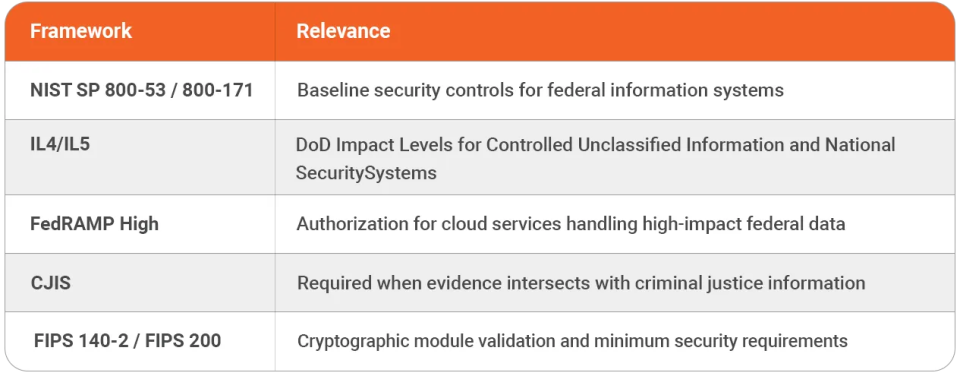
A platform that supports CJIS-compliant deployments on government cloud infrastructure while also offering on-premises and air-gapped options covers the broadest range of defense deployment scenarios.
Audit Logging and Evidence Integrity
Every interaction with evidence must be logged: who accessed it, when, from where, and what they did. Defense investigations demand comprehensive audit trails that capture IP addresses, usernames, timestamps, and event details. These logs must be stored in tamper-proof, WORM-enabled storage to prevent alteration.
SHA-256 hash-based tamper detection provides cryptographic verification that evidence has not been modified since ingestion. For defense agencies, this capability directly supports the chain of custody for digital evidence, ensuring admissibility in military tribunals, federal courts, and international proceedings.
Deployment Models That Meet Defense Requirements
One of the most consequential decisions defense agencies face is how and where their evidence management platform is deployed. The operational environment dictates which deployment model is appropriate.
Government Cloud
For agencies that need cloud scalability while maintaining compliance with federal security frameworks, deployment on Azure Government Cloud or AWS GovCloud supports FedRAMP High, IL4/IL5, NIST 800-53, and CJIS requirements. Government cloud deployments provide dedicated infrastructure that meets DoD data residency and sovereignty requirements while enabling remote access for authorized personnel.
On-Premises
Classified environments and Sensitive Compartmented Information Facilities (SCIFs) require evidence management systems that operate entirely within the agency's own infrastructure. On-premises deployment gives the organization complete control over security configuration, data management, and network isolation. Air-gapped deployments go further: the system operates with no external network access, and all processing, including AI analysis, runs locally.
Hybrid
Many defense organizations operate across multiple classification levels simultaneously. A hybrid deployment model allows sensitive evidence to remain on-premises or in air-gapped environments while less restricted material leverages cloud infrastructure for broader collaboration. This approach optimizes both security and operational efficiency.
AI Capabilities for Defense Evidence Analysis
The volume of digital evidence in defense investigations has grown beyond what manual review can sustain. AI-powered processing accelerates analysis without compromising security.
Transcription and translation. Automatic speech-to-text transcription in 82 languages enables investigators to search spoken content across multilingual evidence. Automatic translation into 50+ languages breaks down language barriers in multinational investigations.
Object and activity detection. AI-powered object detection identifies persons, vehicles, license plates, weapons, and other items of interest across video evidence. Activity recognition can flag specific behaviors, enabling investigators to focus review time on high-relevance segments rather than watching hours of footage.
KLV sensor data extraction. For drone and aerial surveillance footage, automated extraction of KLV sensor metadata maps evidence to geographic coordinates, altitude, and other operational parameters. This is essential for defense investigations involving geospatial intelligence.
Evidence summarization. AI-generated summaries of lengthy audio and video files extract key points, enabling investigators and commanders to rapidly assess evidence without reviewing entire recordings.
Speaker diarization and sentiment analysis. Differentiating speakers in multi-party recordings and analyzing sentiment patterns supports intelligence analysis workflows where understanding who said what (and how) matters as much as the content itself.
For defense deployments, all AI processing must be available for on-premises and air-gapped execution. No evidence data should leave the controlled environment for cloud-based AI processing unless explicitly authorized.
Secure Multi-Agency Collaboration Without Compromising Information Segregation
Defense investigations frequently involve multi-agency evidence sharing between organizations with different security clearances, network environments, and operational mandates. The evidence management platform must enable collaboration while enforcing strict compartmentalization.
Portal-based multi-tenant architecture addresses this by creating separate portals per agency, department, or classification level, each with independent security settings, user management, and access controls. An investigator in one portal cannot see or access evidence in another portal unless explicitly granted access.
Limited-access URLs enable time-bounded, monitored evidence sharing with external partners. Evidence can be shared with prosecutors, allied agencies, or oversight bodies without granting persistent access to the platform. Each URL is per-user tokenized, ensuring every access event is attributable to a specific recipient.
Community and source evidence portals allow controlled evidence submission from field operatives, informants, or allied forces without exposing the internal evidence repository. Submitted evidence flows through content moderation workflows before being accepted into the system.
How VIDIZMO DEMS Addresses Defense Evidence Requirements
VIDIZMO Digital Evidence Management System is purpose-built for the security and operational demands covered in this guide. It supports government cloud (IL4/IL5, FedRAMP High), on-premises, and air-gapped deployments, with all AI capabilities available for local processing in classified environments.
Portal-based multi-tenant architecture enforces strict evidence segregation across agencies and classification levels, while SHA-256 tamper detection, WORM audit logging, AES-256 encryption, and chain-of-custody reporting ensure evidence integrity from field collection to courtroom presentation.
Ready to see VIDIZMO Digital Evidence Management System in action? Request a demo tailored to your agency's requirements.

About the Author

Jump to

Top BWC Evidence Management Challenges and How to Solve Them

Multi-Agency Evidence Sharing: How to Collaborate Securely


No Comments Yet
Let us know what you think