
By Ali Rind on April 2, 2026

Digital evidence today is not just stored, it is reviewed, shared, challenged, and relied upon in legal and investigative outcomes. How that evidence is deployed, whether on-premises, in the cloud, as a hybrid model, or as SaaS, directly affects access control, chain of custody, collaboration, and long-term compliance.
For law enforcement agencies, prosecutors, law firms, government bodies, and enterprises, choosing a digital evidence management deployment model is rarely a purely technical decision. It determines where evidence resides, who can access it, how securely it can be shared, and how well it stands up to scrutiny in audits and court proceedings.
There is no single deployment approach that fits every operational or legal environment. Organizations must evaluate on-premises, cloud, hybrid, and SaaS digital evidence management in the context of their regulatory obligations, workflow requirements, IT capabilities, and future scalability.
This guide breaks down each deployment model clearly and objectively to help decision-makers understand how they work, what they enable, and what to consider before selecting the right approach.
Understanding Deployment Models in Digital Evidence Management
In digital evidence management, a deployment model defines where evidence is stored, how it is accessed, and who controls the underlying infrastructure throughout the evidence lifecycle. This choice affects how evidence is ingested, reviewed, shared, retained, and presented in legal or investigative contexts.
Because digital evidence must remain secure, traceable, and defensible, deployment architecture directly influences:
- Evidence integrity and protection against unauthorized access
- Chain of custody and auditability
- Data residency and jurisdictional control
- Access and collaboration across investigators, prosecutors, and legal teams
- System availability and long-term governance
Deployment models also determine operational responsibility, whether managed internally, shared, or handled by a service provider. This balance impacts compliance, risk management, and resource planning.
Understanding these implications is essential before evaluating on-premises, cloud, hybrid, and SaaS digital evidence management options.
Overview of Digital Evidence Management Deployment Models
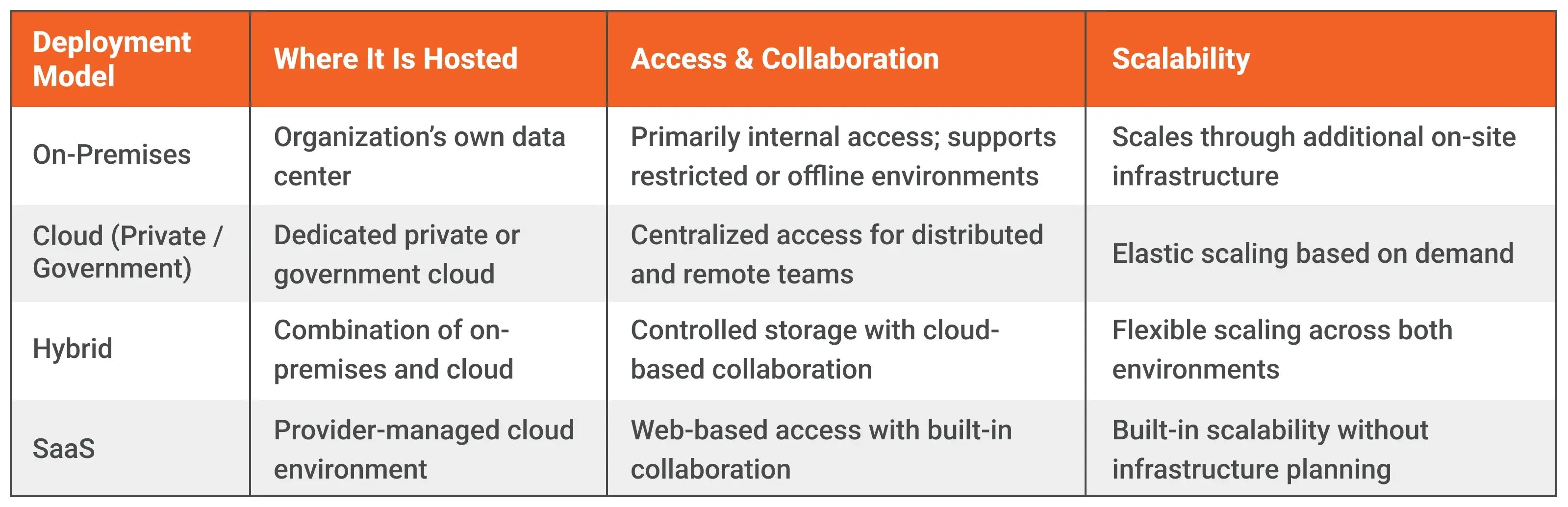
1. On-Premises Digital Evidence Management
On-premises digital evidence management is installed and operated within an organization’s own infrastructure, typically in a controlled data center environment.
How it works
The system runs on organization-owned servers, storage, and networking equipment. Internal teams manage system availability, upgrades, and security controls.
Key characteristics
- Full ownership of infrastructure and data
- Strict control over data residency and access policies
- Ability to operate in restricted or disconnected environments
- Direct responsibility for performance, backups, and disaster recovery
Operational considerations
- Requires internal IT resources for maintenance and scaling
- Hardware procurement and lifecycle management must be planned
- Scaling storage and compute capacity may require additional investment
This model is commonly evaluated where regulatory control, isolation, or offline capability is required.
2. Cloud Digital Evidence Management
Cloud digital evidence management is deployed in dedicated private or government cloud environments rather than shared public infrastructure.
How it works
The system runs in a cloud environment designed to meet security, compliance, and sovereignty requirements, while allowing centralized management.
Key characteristics
- Region-specific or sovereign cloud deployment
- Elastic scalability for growing evidence volumes
- Centralized access for distributed teams
- Cloud-native security, monitoring, and availability controls
Operational considerations
- Clear governance is required for access and data movement
- Connectivity plays a role in availability and performance
- Compliance approvals may be needed depending on jurisdiction
Cloud deployment is often evaluated where scalability, availability, and regional data control are key priorities.
3. Hybrid Digital Evidence Management
Hybrid digital evidence management combines on-premises systems with cloud-based components to balance control and accessibility.
How it works
Sensitive or high-risk data remains on-premises, while cloud infrastructure supports collaboration, sharing, or remote access.
Key characteristics
- Controlled storage with expanded accessibility
- Support for cross-agency or remote collaboration
- Gradual adoption of cloud capabilities
- Separation of storage and access layers
Operational considerations
- Requires well-defined data flow and access policies
- Integration between environments must be carefully managed
- Governance models must align across both deployments
Hybrid deployment is often considered when organizations need operational flexibility without fully centralizing data in one environment.
4. SaaS Digital Evidence Management
SaaS digital evidence management delivers the system as a fully managed service, with infrastructure, updates, and maintenance handled by the provider.
How it works
Organizations access the system through a secure web interface, while the provider manages hosting, updates, and scalability.
Key characteristics
- Faster implementation with minimal infrastructure setup
- Automatic updates and platform enhancements
- Built-in scalability as evidence volumes increase
- Reduced internal IT responsibility
Operational considerations
- Customization options may vary
- Long-term costs follow a subscription model
- Availability depends on service reliability and connectivity
SaaS deployment is often evaluated by organizations prioritizing speed, simplicity, and reduced operational overhead.
Security, Chain of Custody, and Compliance Across Deployment Models
Regardless of deployment choice, digital evidence management systems must support:
- Secure evidence ingestion and storage
- Immutable audit trails and chain of custody tracking
- Role-based access control and authentication
- Encryption at rest and in transit
- Retention, disposal, and legal hold policies
Deployment models influence how these controls are implemented, not whether they exist. Evaluation should focus on how each model aligns with compliance obligations and internal governance.
Key Factors to Evaluate Before Choosing a Deployment Model
When comparing digital evidence management deployment options, organizations should evaluate how each model aligns with operational, legal, and technical requirements across the evidence lifecycle.
-
Security architecture and audit requirements
Assess how security controls are implemented, monitored, and audited, including access controls, logging, and the ability to demonstrate evidentiary integrity during reviews or legal proceedings. -
Data residency and jurisdictional constraints
Consider where evidence data is physically stored and how deployment models support compliance with local, regional, or national data protection and sovereignty regulations. -
Evidence growth and long-term scalability
Evaluate how well the deployment model supports increasing volumes of digital evidence over time, including storage expansion, performance, and future capacity planning. -
IT staffing and operational ownership
Determine the level of internal IT involvement required for system maintenance, updates, security management, and infrastructure support under each deployment model. -
Remote access and collaboration needs
Review how investigators, prosecutors, attorneys, and authorized external parties access and share evidence securely across locations and organizations. -
Budget predictability and total cost of ownership
Examine upfront costs, ongoing operational expenses, and long-term financial impact, including infrastructure, licensing, maintenance, and support.
Evaluating these factors together helps organizations select a deployment model that aligns with both current operational needs and long-term strategic goals.
Deployment Considerations by Organization Type
Organizations evaluate digital evidence management deployment models based on their role in the evidence lifecycle, legal obligations, and collaboration requirements.
Law Enforcement Agencies
Law enforcement agencies focus on secure evidence ingestion, preservation of chain of custody, controlled access across investigative teams, operation in limited-connectivity environments, and compliance with internal and external regulations.
Government and Public Sector Organizations
Government organizations emphasize data sovereignty, policy-driven access controls, audit readiness, alignment with public sector security frameworks, and long-term data retention.
Prosecutors and District Attorney Offices
Prosecutors assess deployment models based on secure access to submitted evidence, efficient review and redaction, controlled sharing with courts and defense counsel, auditability, and long-term retention requirements.
Law Firms and Legal Teams
Law firms prioritize secure receipt and storage of evidence, role-based access for case teams, remote collaboration, protection of legal privilege, and predictable costs with minimal IT complexity.
Enterprises and Corporate Security Teams
Enterprises evaluate deployment models based on scalability, integration with existing IT systems, support for internal investigations, operational efficiency, and secure cross-department collaboration.
Choosing a Platform That Supports Multiple Deployment Models
Deployment needs for digital evidence can change over time due to policy updates, evidence growth, collaboration requirements, or regulatory obligations. Selecting a digital evidence management system that supports multiple deployment models helps organizations adapt without replacing their platform.
Flexibility allows teams to align deployment choices with current requirements while retaining the option to evolve as operational or compliance needs change.
VIDIZMO Digital Evidence Management System supports on-premises, cloud, hybrid, and SaaS deployments, enabling organizations to manage digital evidence securely across different operational environments without compromising chain of custody or compliance.
This approach helps reduce long-term risk and avoid deployment lock-in.
Need guidance selecting a deployment model for digital evidence management? Book a meeting to review your requirements and understand how VIDIZMO Digital Evidence Management System can adapt to your environment.

Key Takeaways
-
The deployment model is a core component of digital evidence management strategy.
Where and how a system is deployed directly affects security controls, chain of custody, access management, and compliance readiness. -
On-premises, cloud, hybrid, and SaaS deployments address different operational requirements.
Each digital evidence management deployment model supports specific needs related to data residency, scalability, IT ownership, and collaboration. -
Security, chain of custody, and compliance remain essential across all deployment options.
The difference lies in how these controls are implemented, governed, and audited, not whether they exist. -
Deployment decisions must align with legal, investigative, and organizational workflows.
Law enforcement agencies, prosecutors, law firms, government organizations, and enterprises evaluate deployment models based on their role in the evidence lifecycle. -
Long-term flexibility helps organizations manage change and reduce risk.
Selecting a digital evidence management system that supports multiple deployment models allows organizations to adapt to evolving regulatory, operational, and scalability requirements.
Deployment Strategy as a Foundation for Digital Evidence Management
Selecting the right digital evidence management deployment model is a strategic decision that extends beyond infrastructure. It shapes how securely evidence is handled, how reliably chain of custody is maintained, how stakeholders collaborate, and how organizations meet legal and regulatory obligations over time.
On-premises, cloud, hybrid, and SaaS deployments each support different operational realities. The suitability of any model depends on security posture, data residency requirements, scalability expectations, IT ownership, and evidence access across investigative and legal workflows.
A clear understanding of these deployment approaches allows organizations to align digital evidence management with both current needs and long-term objectives. Treating deployment as a requirement-driven strategy helps reduce risk, support compliance, and maintain continuity across the digital evidence lifecycle.
About the Author

Jump to

AI-Enabled On-Prem Digital Evidence Management Systems: A Buyer’s Guide

Cloud Based Evidence Management System: A Guide for Law Enforcement


No Comments Yet
Let us know what you think