
By Ali Rind on February 27, 2026
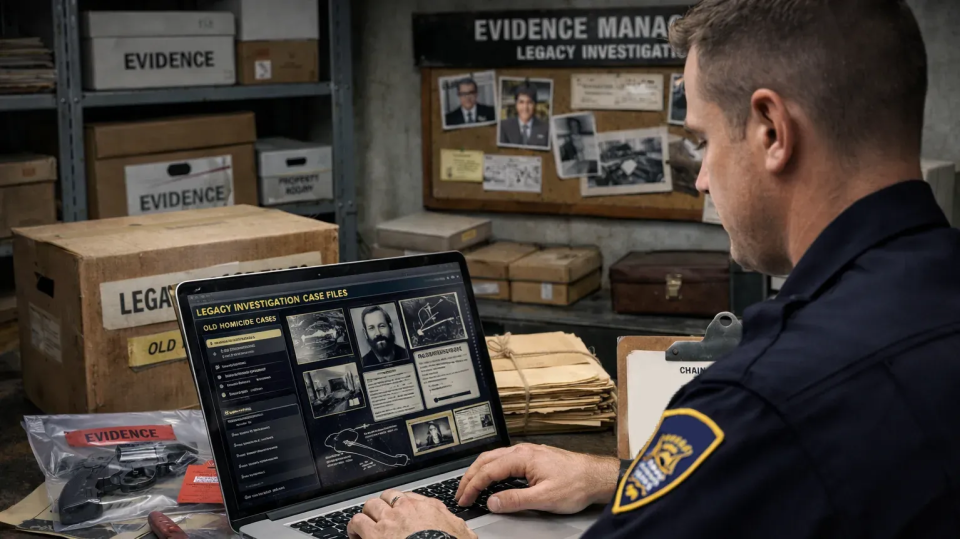
Across the United States, more than 250,000 homicides remain unsolved. Behind each statistic is a case file often stored in a warehouse, on aging DVDs, or in a records management system that predates modern search capabilities. Detectives know the evidence exists. The problem is finding the needle in a haystack when the haystack fills an entire storage facility.
Artificial intelligence is changing that equation. In January 2026, agencies began reporting that AI tools could compile and cross-reference evidence across 27 cases in just 30 hours, work that would take a single investigator an estimated 81 years to complete manually. But here is the part most coverage overlooks: AI cannot analyze evidence it cannot access.
Before any algorithm can surface a lead buried in a decade-old recording, that evidence must be digitized, ingested into a modern platform, and made searchable. That foundation is a Digital Evidence Management System (DEMS), and it is the prerequisite every cold case AI breakthrough depends on. For a broader look at how AI-powered digital evidence management is reshaping investigations today, see our 2025 overview.
This article is part of our comprehensive guide to digital evidence lifecycle management, covering how agencies manage evidence from collection through disposition.
Why Cold Cases Go Cold
Cold cases rarely stall because detectives lack motivation. They stall because the evidence is inaccessible at scale.
Consider what a typical cold case archive contains:
- VHS tapes and audio cassettes from witness interviews conducted in the 1990s
- DVDs and CDs burned from early digital camera systems with proprietary codecs
- Paper case files and photographs that were never scanned
- Analog surveillance footage from closed-circuit systems that no longer exist
- Call recordings and voicemails stored on legacy phone systems
Much of this evidence has never been transcribed, indexed, or made searchable. An investigator reopening a case from 2008 may need to watch 40 hours of interview recordings just to find a single statement that contradicts a later alibi. Multiply that across dozens of cases, and the math becomes impossible for resource-constrained agencies. The challenges of physical evidence storage run deep, and legacy media compounds every one of them.
The bottleneck is not intelligence. It is infrastructure.
What AI Can Actually Do for Cold Cases
When legacy evidence is digitized and loaded into a modern evidence management platform, AI capabilities transform what investigators can accomplish in hours instead of months. For a detailed breakdown of how AI digital evidence analysis works in practice, see our dedicated guide.
Automatic Transcription Across 82 Languages
Cold cases often involve recordings in languages other than English, including witness statements from immigrant communities, intercepted calls, or interviews requiring translators. VIDIZMO DEMS provides automatic transcription in 82 languages with published word error rate (WER) benchmarks, turning hours of audio into searchable text. Investigators can search transcripts for names, addresses, phrases, or keywords across every recording in a case, or across multiple related cases simultaneously.
Speaker Diarization
Old interview recordings frequently contain multiple speakers with no labels. Speaker diarization automatically identifies and differentiates speakers within a recording, tagging who said what and when. This allows investigators to isolate a specific person's statements across hours of footage without listening to the entire recording.
Object Detection and Tracking
AI-powered object detection scans video evidence for faces, persons, vehicles, license plates, weapons, and dozens of other object types. For cold cases, this means an investigator can search archived surveillance footage for a specific vehicle type or identify every appearance of a person across multiple camera feeds, work that would take weeks of manual review.
Summarization and Automatic Chaptering
Lengthy recordings, including jail calls, interview sessions, and surveillance footage, can be summarized by AI to extract key points without requiring an investigator to watch or listen to the full recording. Automatic chaptering breaks long-form video into segments, making it easier to navigate directly to relevant portions.
Topic Modeling and Sentiment Analysis
AI can automatically identify recurring themes across evidence (topic modeling) and analyze emotional patterns in recordings (sentiment analysis). In cold cases, these capabilities can surface connections that human reviewers might miss, such as a recurring name mentioned across unrelated interviews or a shift in tone that suggests deception.
Cross-Evidence AI Search
Perhaps the most powerful capability for cold case work is AI-powered search that operates across all evidence types simultaneously. Investigators can search metadata, transcripts, AI-generated tags, spoken words, detected objects, and visual content in a single query. A search for "blue sedan" returns not just tagged photos but also transcript segments where witnesses described the vehicle and video frames where the AI detected a matching car.
The Evidence Management Foundation AI Requires
AI tools do not operate in a vacuum. They require evidence to be in a specific state before analysis can begin. This is where a Digital Evidence Management System (DEMS) becomes essential. For a full overview of the challenges and strategies in digital evidence management, see our dedicated resource.
Step 1: Digitize and Ingest Legacy Evidence
The first challenge is getting old evidence into a modern system. A DEMS built for this purpose supports:
- 255+ media formats, including legacy video codecs, proprietary camera formats, scanned documents, and analog-to-digital conversions
- Bulk upload to ingest entire archives of digitized evidence in batch operations rather than one file at a time
- Watch folders that monitor designated directories and automatically ingest new files as they are added, which is critical when a digitization team is converting physical media on an ongoing basis
- Multi-source ingestion to accept evidence from body-worn cameras, dash cameras, CCTV systems, interview room recordings, mobile devices, and third-party platforms through a single intake pipeline
Step 2: Process with AI
Once evidence is ingested, the DEMS AI processing pipeline runs automatically:
- Audio and video files are transcribed in the detected language (or a specified language)
- Objects, faces, and vehicles are detected and tagged throughout video files
- Speakers are identified and differentiated
- Content is summarized and chaptered
- Metadata is extracted and indexed
- All AI-generated data becomes searchable alongside original metadata
This processing happens at scale. An agency can ingest 500 digitized recordings on Monday and have fully searchable, transcribed, tagged evidence by Tuesday, without a single investigator listening to a minute of audio manually.
Step 3: Maintain Chain of Custody
Cold case evidence carries the same admissibility requirements as any active case. Every piece of evidence, from the moment it enters the system, must maintain an unbroken chain of custody. Understanding what happens when the chain of custody breaks makes clear why automated safeguards are non-negotiable. A DEMS provides:
- SHA-256 hash-based tamper detection that verifies no evidence has been altered after ingestion
- Comprehensive audit logging that records every access, view, download, share, and modification with IP address, username, and timestamp
- Chain of custody reports exportable as PDF and CSV for court proceedings
- WORM-enabled storage with tamper-proof audit logs that cannot be altered or deleted
Step 4: Search, Analyze, and Share
With evidence processed and integrity verified, investigators can:
- Run cross-case searches to identify connections between previously unlinked cases using AI-powered case management
- Share specific evidence with prosecutors, forensic labs, or partner agencies through secure, time-limited access links following best practices for secure evidence sharing
- Annotate videos and documents with findings for case review
- View multiple camera angles in a synchronized mosaic view to reconstruct events
Operational Considerations for Cold Case Programs
Evidence Integrity for Legacy Media
When digitizing old tapes and discs, agencies must document the conversion process as part of the chain of custody. A DEMS that generates hash values at the point of ingestion establishes a verifiable baseline for every digitized file, ensuring the digital copy is treated as an authentic representation of the original. Best practices for digital evidence preservation apply here just as they do for active cases.
Deployment Security
Cold case evidence often includes sensitive material such as informant recordings, undercover operations, and victim statements. Agencies that require on-premises storage for data sovereignty can deploy a DEMS on their own infrastructure or in a hybrid model. This deployment flexibility ensures that sensitive legacy evidence does not need to leave the agency's secure environment to benefit from AI processing.
Admissibility of AI-Derived Insights
AI-generated transcripts, object tags, and summaries are investigative aids, not standalone evidence. Courts require human verification of AI outputs. A responsible approach uses AI to surface leads and narrow the evidence set, then relies on investigators and forensic experts to validate findings before presenting them in court. The DEMS audit trail documents both the AI processing and the human review, supporting admissibility.
Multilingual Evidence
Agencies investigating cold cases in diverse communities encounter evidence in multiple languages. With transcription support for 82 languages and translation into 50+ languages, investigators can search and review evidence without depending on the availability of human translators, accelerating timelines from weeks to hours.
How VIDIZMO DEMS Supports Cold Case Reinvestigation
VIDIZMO DEMS provides the end-to-end infrastructure that makes AI-powered cold case analysis possible:
- Ingest legacy evidence at scale with 255+ format support, bulk upload, and watch folders that handle any media type from any era
- Apply AI automatically, including transcription in 82 languages, object detection, speaker diarization, summarization, and topic modeling as part of the processing pipeline
- Search across everything using AI-powered search that queries metadata, transcripts, visual content, and detected objects simultaneously
- Maintain court-ready integrity with SHA-256 tamper detection, WORM storage, and exportable chain of custody reports that satisfy admissibility requirements
- Deploy securely with on-premises, government cloud, or hybrid deployment options that keep sensitive evidence within agency control
- Share with accountability using per-user tokenized URLs, time-limited access, and access reason provisioning to ensure that shared evidence is tracked and controlled
Ready to turn your cold case backlog into actionable intelligence? See how VIDIZMO Digital Evidence Management System works and book a demo today.

Getting Started with AI-Powered Cold Case Review
Agencies considering an AI-driven cold case program can follow a practical path:
- Audit the archive. Inventory legacy evidence by media type, format, and condition. Identify what needs digitization versus what is already in digital format.
- Prioritize by case severity. Start with the highest-priority unsolved cases where evidence volume is substantial enough to benefit from AI processing.
- Establish a digitization workflow. Set up watch folders in the DEMS to automatically ingest files as they are converted from physical media.
- Run AI processing. Let the platform transcribe, tag, and index the evidence. Review AI outputs for quality on the first batch before scaling up.
- Search for cross-case connections. Use AI-powered search to identify names, locations, vehicles, and patterns that span multiple cases.
- Document findings with full audit trails. Every AI-generated insight and investigator action is logged, maintaining the evidentiary chain for court.
Building the Foundation for AI-Powered Cold Case Work
AI is not a magic wand for cold cases. It is a force multiplier, one that can process in hours what would take investigators months or years to review manually. But that force multiplier only works when legacy evidence is digitized, ingested, processed, and made searchable within a secure, compliant evidence management platform.
The agencies solving cold cases with AI in 2026 are not simply buying an analytics tool. They are building the evidence management infrastructure that makes AI analysis possible in the first place. For agencies ready to give their cold cases a second chance, the starting point is the same: get the evidence into a system that can work with it.
About the Author

Jump to

Zero Trust Security for Digital Evidence Systems Explained

What Is Digital Claims Processing? Complete Guide for Insurance Carriers


No Comments Yet
Let us know what you think