
By Ali Rind on January 14, 2026

Generative AI has quickly transformed writing, documentation, and administrative tasks across nearly every sector. Tools like ChatGPT reached mass adoption at unprecedented speed, but consumer AI was never designed to handle sensitive criminal justice data or produce evidentiary documentation.
As agencies evaluate AI-assisted police report writing, the key distinction emerges:
general-purpose AI tools generate text; public-safety-grade AI transforms evidence into defensible documentation.
This blog breaks down the critical differences between VIDIZMO Case Intelligence Hub and consumer-grade Gen AI tools, and why choosing the right one determines whether your reports become a powerful operational asset or a potential liability.
What Automated Police Report Writing Actually Requires
Automated report writing for law enforcement is not a simple summarization task. It must:
- Reference verified evidence, not assumptions
- Maintain CJIS-compliant security controls
- Preserve chain of custody and audit logs
- Use law-enforcement-specific language and templates
- Avoid hallucinations (a major problem with consumer AI)
- Support multi-source inputs (video, audio, images, transcripts, metadata)
- Produce court-ready documentation
Most consumer Gen AI systems cannot do any of this.
Why General-Purpose AI Falls Short for Police Reporting
Consumer AI models are designed for flexible, open-ended tasks—writing stories, summarizing text, brainstorming ideas. This flexibility becomes a liability when applied to law enforcement.
Key issues with consumer AI include:
- Variable accuracy
- Missing context
- Risk of hallucinations
- No built-in compliance requirements
- No chain-of-custody records
- Lack of evidence-grounded reasoning
Police narratives cannot rely on imagination, inference, or unverifiable statements. That is where VIDIZMO’s evidence-aware AI fundamentally differs.
VIDIZMO Case Intelligence Hub vs. Consumer Gen AI
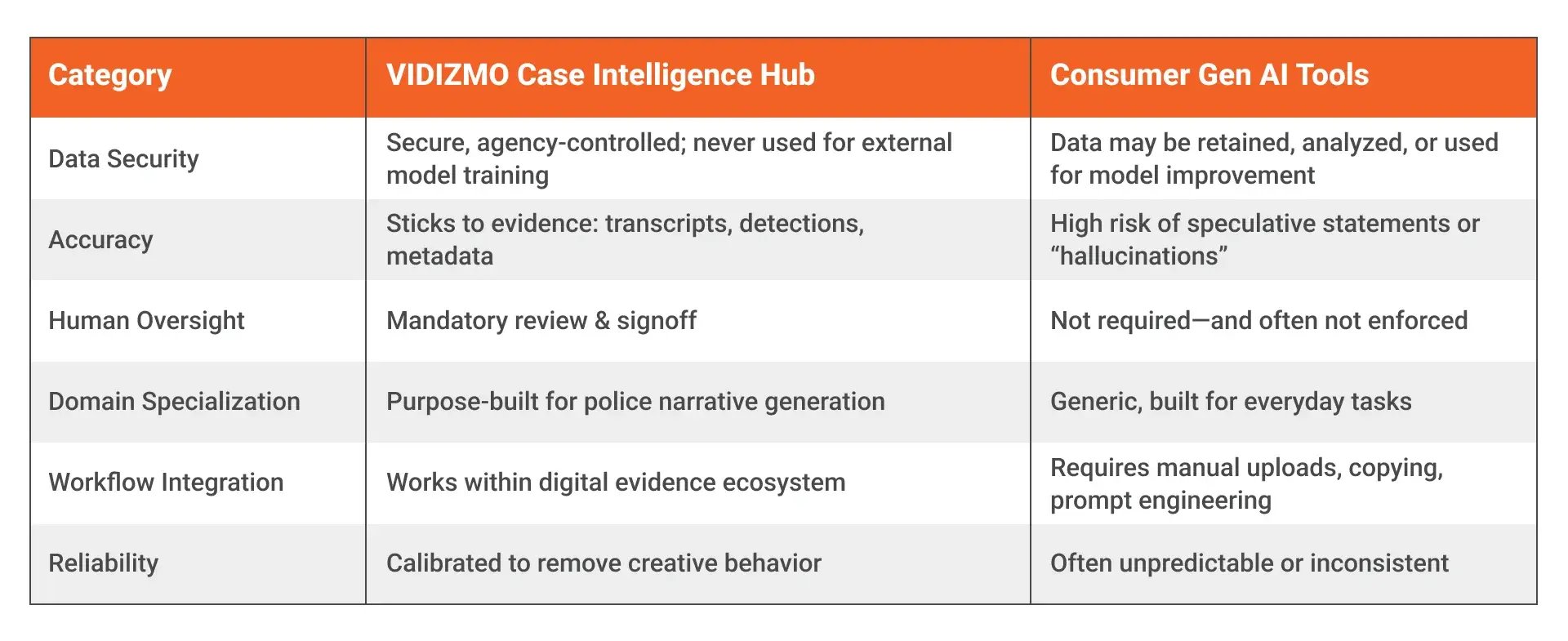
How VIDIZMO Case Intelligence Hub Approaches Report Generation
VIDIZMO Case Intelligence Hub is designed to draft police narratives using an evidence-grounded approach, meaning the AI bases its output on information extracted directly from digital evidence stored in the system. This includes elements such as:
- Transcripts from audio and video files
- Detected objects, speakers, and events
- Timestamps and sequence metadata
- Officer-supplied notes and contextual details
The model is calibrated to avoid inserting speculative or unverifiable statements, relying instead on the factual inputs available in the evidence. When information is missing or unclear, the system flags those gaps so officers can fill them in manually.
Rather than trying to “guess” what happened, Case Intelligence Hub helps officers construct a clear, structured narrative rooted in what the evidence actually shows. The final responsibility remains with the officer, who reviews and validates each AI-assisted draft before submission.
Security You Can Trust for Sensitive Case Data
Consumer AI platforms often retain input data or use it to improve their models—a major risk for law enforcement. Lawsuits and investigations into AI data practices underscore why agencies must avoid exposing criminal justice information to public AI systems.
VIDIZMO Case Intelligence Hub ensures:
- Evidence stays within agency-controlled environments
- No data is used to train external AI systems
- Full encryption and access controls
- Configurable retention policies
- Audit trails documenting all interactions
This protects case integrity and maintains compliance with strict criminal justice standards.
Maintaining Officer Control and Accountability
Reports generated by consumer AI can be copied, pasted, and submitted with no internal safeguards. This exposes agencies to liability if the content includes inaccuracies or fabricated details.
VIDIZMO Case Intelligence Hub prevents this by requiring:
- Officer review of all autogenerated text
- Manual entry of missing contextual details
- Confirmation that the narrative accurately reflects the evidence
- System-tracked approval logs
This ensures the officer—not the AI—remains the final authority on every report.
Seamless Operation Within Your Digital Evidence Environment
Unlike consumer AI tools requiring manual uploads, copying, and prompt management, VIDIZMO Case Intelligence Hub works inside the agency’s evidence platform.
When evidence is uploaded and processed, the system automatically:
- Transcribes audio and video
- Identifies speakers, objects, and events
- Extracts metadata
- Prepares a structured foundation for AI-assisted drafting
This eliminates delays and fragmented workflows.
A Responsible Approach to AI in Law Enforcement
AI should enhance policing—not replace judgment, compromise evidence, or introduce legal risks. VIDIZMO’s approach centers on:
- Human-in-the-loop oversight
- Evidence-grounded output
- Transparency
- Secure, controlled environments
- Bias-reduction measures
- Full auditability
This supports responsible AI adoption that aligns with modern policing expectations and public accountability.
Key Takeaways
- VIDIZMO Case Intelligence Hub uses an evidence-grounded approach, generating report narratives from transcripts, detections, metadata, and officer inputs rather than speculative reasoning.
- Consumer Gen AI tools lack law-enforcement safeguards, creating risks of hallucinations, data exposure, and inaccurate narratives that may compromise admissibility.
- VIDIZMO Case Intelligence Hub ensures data remains within agency-controlled environments, never used for external model training or third-party processing, maintaining strict evidentiary integrity.
- Mandatory officer review and validation ensure that every report draft remains accurate, complete, and defensible in court.
- Purpose-built policing safeguards—such as structured templates, evidence-aware logic, and audit trails—make Case Intelligence Hub far more reliable than generic AI tools.
- Workflow-level integration inside the digital evidence system allows report drafting immediately after transcription and metadata extraction, eliminating manual transfers and delays.
- Responsible AI principles guide VIDIZMO’s design, ensuring transparency, human oversight, and alignment with modern policing requirements.
Why Evidence-Aware AI Matters for Police Reporting
VIDIZMO Case Intelligence Hub offers a secure, evidence-driven, and legally defensible approach to automated police report writing—something consumer AI tools simply cannot provide. By grounding narratives in verified evidence, enforcing officer oversight, and operating within secure agency environments, VIDIZMO supports accurate reporting while reducing administrative burden.
Consumer Gen AI tools may be useful for general writing tasks, but they cannot generate legally defensible, evidence-based police reports. For agencies that must protect the chain of custody, avoid AI hallucinations, and produce court-ready documentation, the choice is clear.
Ready to see how VIDIZMO Case Intelligence Hub transforms report writing for modern law enforcement?
Start your free trial or request a personalized demo today.
People Also Ask
What is VIDIZMO Case Intelligence Hub for automated police report writing?
VIDIZMO Case Intelligence Hub is an AI-assisted reporting tool built into VIDIZMO’s digital evidence system. It generates draft police narratives using evidence inputs like transcripts, detections, and metadata rather than creative assumptions.
How does VIDIZMO Case Intelligence Hub differ from consumer Gen AI tools?
While consumer Gen AI models generate general text, VIDIZMO Case Intelligence Hub produces evidence-grounded police reports within a secure environment, ensuring accuracy, officer oversight, and legal defensibility.
Is AI-generated police report writing dependable for law enforcement?
AI-generated reports are dependable only when the system is designed for law enforcement. VIDIZMO Case Intelligence Hub uses factual evidence inputs and requires officer validation, making it reliable for incident reporting.
Can consumer Gen AI tools be used for automated police report writing?
Consumer Gen AI tools are not suitable for automated police report writing because they lack security controls, evidence integration, chain-of-custody safeguards, and may generate hallucinated or unverified information.
Does VIDIZMO Case Intelligence Hub maintain chain of custody?
Yes, VIDIZMO maintains full audit trails and chain-of-custody logs for all actions taken during the report generation process, ensuring traceability and compliance.
How does VIDIZMO ensure accuracy in AI-assisted narratives?
VIDIZMO’s model is calibrated to rely on evidence inputs and avoid speculation. Officers are prompted to review all drafts, fill information gaps, and certify the final narrative.
Is VIDIZMO Case Intelligence Hub secure for sensitive police data?
VIDIZMO processes evidence entirely within agency-controlled, secure environments. Data is never used for external AI training, ensuring confidentiality and compliance with criminal justice standards.
About the Author

Jump to
.webp)
AI Police Report Writing vs. Gen AI: Best for Law Enforcement?

Top 5 Digital Evidence Management Tools for Criminal Case Data Sharing
.webp)

No Comments Yet
Let us know what you think