Surveillance footage has become one of the most sought-after evidence types in both civil and criminal litigation. Slip-and-fall claims, employment disputes, commercial fraud, and criminal prosecutions increasingly turn on what a camera captured at a specific time. Yet most law firms have no structured system for receiving, organizing, authenticating, or searching CCTV footage. It arrives as raw files in inconsistent formats, sits in general-purpose cloud storage, and is reviewed manually when needed.
That approach creates legal exposure at every stage. This guide addresses the three structural problems law firms face with CCTV evidence, what legal admissibility requires, and how a purpose-built Digital Evidence Management System addresses all of it in a single platform. For a broader overview of digital evidence practices, see our complete guide to digital evidence management.
Why CCTV Footage Is Now a Primary Evidence Type in Civil and Criminal Matters
Surveillance cameras are embedded in commercial and public infrastructure to a degree that was unimaginable a decade ago. Retail stores, parking structures, office buildings, transportation hubs, residential complexes, and municipal systems all generate continuous footage. The result is that for any incident occurring in or near a built environment, there is almost always video of it.
In civil litigation, CCTV footage is the decisive evidence in premises liability, workers' compensation disputes, and commercial fraud matters. In criminal proceedings, it corroborates or contradicts witness testimony and places defendants at scenes. In employment and internal investigations, building access and common area cameras provide an objective record of events in dispute.
This means law firms are receiving CCTV footage as evidence not occasionally but routinely. The volume per matter has increased substantially as building surveillance systems have expanded to more cameras with longer retention windows, generating footage from multiple vantage points across extended timeframes.
The Three Problems Law Firms Face with CCTV Evidence
Why CCTV Footage Is Now a Primary Evidence Type in Civil and Criminal Matters
Surveillance cameras are embedded in commercial and public infrastructure to a degree that was unimaginable a decade ago. Retail stores, parking structures, office buildings, transportation hubs, residential complexes, and municipal systems all generate continuous footage. The result is that for any incident occurring in or near a built environment, there is almost always video of it.
In civil litigation, CCTV footage is the decisive evidence in premises liability, workers' compensation disputes, and commercial fraud matters. In criminal proceedings, it corroborates or contradicts witness testimony and places defendants at scenes. In employment and internal investigations, building access and common area cameras provide an objective record of events in dispute.
This means law firms are receiving CCTV footage as evidence not occasionally but routinely. The volume per matter has increased substantially as building surveillance systems have expanded to more cameras with longer retention windows, generating footage from multiple vantage points across extended timeframes.
The Three Problems Law Firms Face with CCTV Evidence
Despite its evidentiary value, CCTV footage creates three structural problems for legal teams that do not have the right infrastructure.
Problem 1: Format fragmentation
Surveillance systems use a wide range of proprietary and open formats: AVI, MP4, MKV, MOV, and manufacturer-specific codec formats from Hikvision, Axis, Bosch, and others. A firm receiving footage from three different building systems in a single matter may receive three incompatible file formats that will not play in standard media software. Converting files for review introduces integrity risk and requires dedicated technical resources.
Problem 2: Volume without structure
A week of footage from a five-camera system generates dozens of files and hundreds of hours of raw video. Without automated indexing, the only way to locate a specific moment is manual review. There is no equivalent of a keyword search for unprocessed video. This problem scales directly with case complexity.
Problem 3: No chain of custody
For CCTV footage to be admissible, the receiving party must demonstrate that the file presented in court is the same file that was originally obtained, that it has not been altered or edited, and that access to it has been documented throughout the litigation. General-purpose cloud storage provides none of this. There are no tamper-detection mechanisms, no automated access logs tied to a legal matter, and no exportable chain-of-custody report. For more on why this matters in court, see our guide on how to secure digital evidence and maintain chain of custody.
Each of these problems is solvable with the right evidence management infrastructure.
What Makes CCTV Footage Legally Admissible
Admissibility of digital video evidence rests on three requirements. Courts and opposing counsel assess each one.
Metadata preservation
The original file metadata, including creation timestamp, camera identifier, and file hash, must be preserved from the moment of receipt. Any modification to the file after ingestion, even a format conversion, creates a metadata discrepancy that can be challenged. A purpose-built DEMS ingests footage without altering the source file and preserves original metadata from the point of receipt.
Tamper detection
The party offering video evidence must be able to prove the file has not been edited between the time it was obtained and the time it is presented. SHA-256 cryptographic hashing generates a unique fingerprint for every file at ingestion. If any bit of the file changes, the hash changes. At production or presentation, the current hash is compared to the original. A match proves the file is identical to what was received. For more on the legal standards governing admissibility, see our digital evidence admissibility guide for prosecutors.
Chain of custody documentation
Every access event, from initial ingestion through review, annotation, sharing, and production, must be logged with user identity, timestamp, IP address, and action type. These logs must be stored in a way that prevents retroactive modification. WORM-enabled (Write Once, Read Many) storage ensures the audit log cannot be deleted or altered after the fact. The chain-of-custody report is exportable as PDF or CSV for court submission or opposing counsel production.
Without these three elements, even genuine, unaltered footage can be challenged successfully on foundation grounds.
How a Purpose-Built DEMS Ingests, Indexes, and Makes CCTV Footage Searchable
VIDIZMO Digital Evidence Management System handles CCTV footage across all three admissibility requirements while adding AI-powered search that eliminates the manual review bottleneck.
Multi-format ingestion without conversion. DEMS supports 255-plus file formats natively, including the proprietary formats used by major surveillance hardware manufacturers. Footage is ingested as received, without format conversion, preserving original metadata throughout. For a breakdown of what capabilities a modern evidence platform should include, see our guide on must-have evidence management system capabilities.
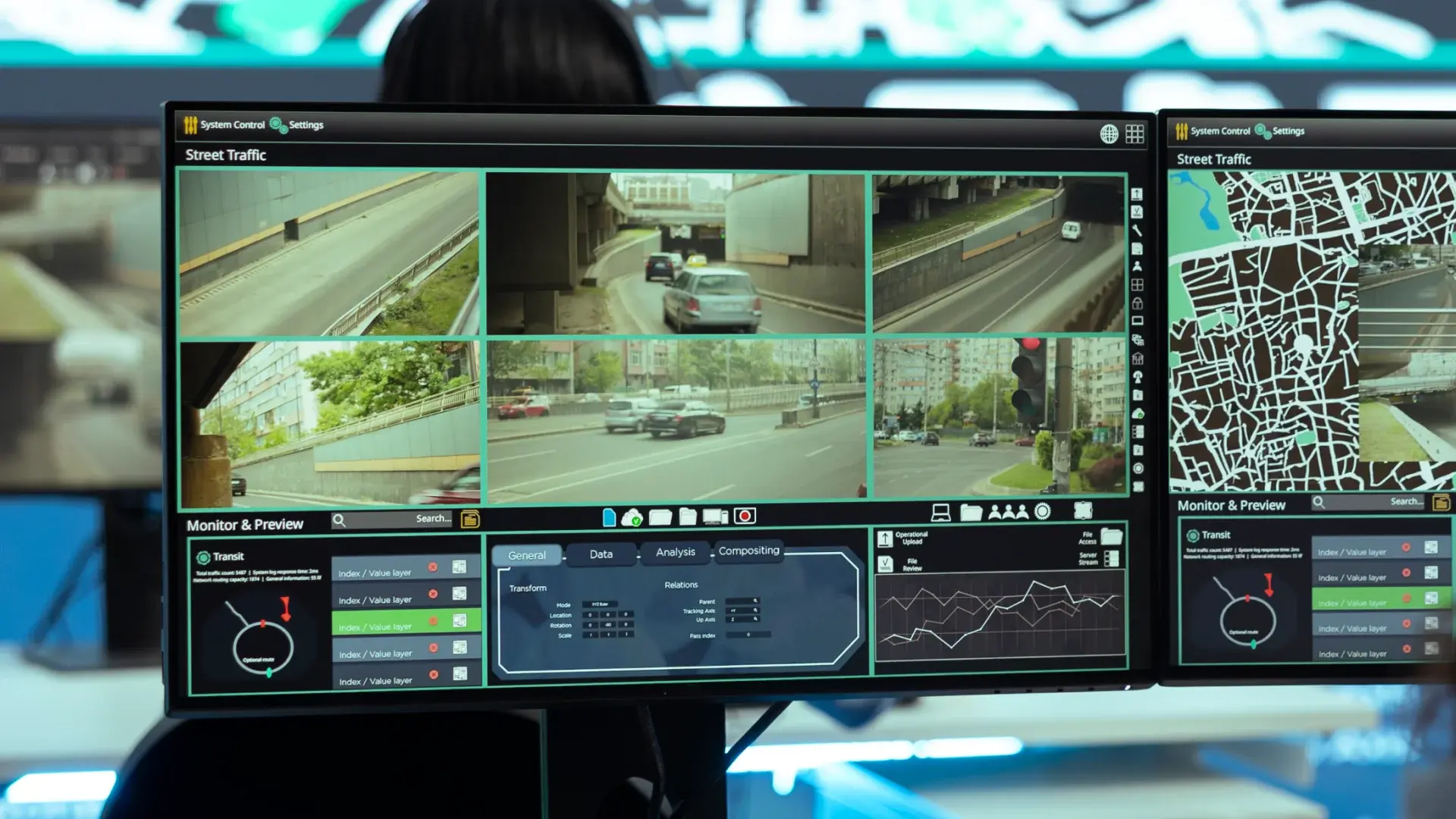
AI indexing at ingestion. When footage is uploaded, AI processing runs automatically. Object detection scans every frame and tags detected items including vehicles by color and type, license plates, persons, and faces, each with timestamps. The footage is converted from a raw file into a structured, searchable index.
Search by object, timestamp, and event. After AI processing, litigation support teams can search across indexed footage by object attribute, time window, or camera location. Finding every frame where a specific vehicle appears, or every moment a door was accessed between certain hours, takes seconds rather than hours.
Tamper detection on every file. Every ingested file receives a SHA-256 hash at intake. Any subsequent modification invalidates the hash and flags the file. The original hash is stored in the audit log alongside the ingestion timestamp.
Audit logging in WORM storage. Every access event across the platform is logged and stored in tamper-proof storage. Logs cannot be deleted or modified by any user, including administrators. The chain-of-custody report is generated automatically and exportable at any point. For more on evidence preservation best practices, see our guide on digital evidence preservation.
Sharing Authenticated Footage with Co-Counsel, Opposing Parties, and Courts
CCTV evidence must move between parties throughout litigation: from client to firm, from firm to co-counsel, from firm to opposing parties during discovery, and from firm to court at presentation. Each transfer is a point where custody documentation and access control matter.
Tokenized expiring links for external access. DEMS generates per-user, time-limited access links for external parties. Each link is unique to the recipient and expires after a defined period. There are no permanent open-access URLs. Every access event through the link is logged against the recipient's identity. For best practices on secure evidence sharing, see our post on secure digital evidence sharing.
Role-based access control at the matter level. Internal access is governed by role-based permissions scoped to the specific matter. A paralegal assigned to a premises liability case can access only the CCTV footage linked to that matter, not footage from other matters on the same platform.
Chain-of-custody continuity across transfers. When footage is exported for production or court presentation, the chain-of-custody log travels with the file. The log documents every access event from initial ingestion through the export itself. Opposing counsel or a court can verify the custody history without requesting additional discovery.
Deployment for data sovereignty. For firms with government clients or international matters, DEMS supports on-premises and private cloud deployment. CCTV footage from sensitive matters never routes through shared infrastructure unless the firm explicitly chooses that configuration.
CCTV Evidence Requires Infrastructure, Not Just Storage
CCTV footage is too valuable and too legally complex to manage in general-purpose cloud storage. The same footage that can resolve a contested claim can be excluded from evidence if the receiving party cannot authenticate it, demonstrate chain of custody, or explain a metadata discrepancy.
A purpose-built digital evidence management system provides the infrastructure that CCTV evidence legally requires: format-agnostic ingestion, AI-powered indexing, SHA-256 tamper detection, WORM-based audit logs, and controlled sharing with automatic chain-of-custody documentation.
Book a DEMS demo to see how CCTV footage is ingested, indexed, and made court-ready, or explore DEMS features to review the full evidence management capability set.






No Comments Yet
Let us know what you think