
By Ali Rind on March 31, 2026
Key Takeaways
- A modern DEMS closes the gap between what law enforcement collects and what prosecutors can actually use at trial.
- Controlled sharing with time-limited, per-attorney access links creates a verifiable disclosure record that protects against Brady challenges.
- Hash-based integrity verification and exportable chain of custody reports are what make video evidence defensible in court.
- AI-powered search and transcription reduce footage review from hours to minutes across a full caseload.
- A dedicated prosecutor portal keeps legal teams working independently from the agency's investigative files.
Digital Evidence Has Outpaced the Prosecution Workflow
A decade ago, presenting video evidence in court meant bringing a DVD and hoping the courtroom AV setup cooperated. Today, a single felony case might involve terabytes of body-worn camera footage, surveillance video from dozens of cameras, dashcam recordings, interview room recordings, drone footage, and forensic device extracts. A prosecutor is expected to organize all of it, review it, share it with the defense, and present it at trial.
The volume problem is real. And it is getting worse. Digital evidence management systems were initially adopted by law enforcement agencies to replace physical evidence rooms, but the platforms that matter most to case outcomes are the ones prosecutors use at the preparation and trial stages. Here is what that workflow actually looks like, and what a modern DEMS changes about it.
The Challenge: Volume and Variety
The average felony case now involves more digital evidence than a mid-2000s major crimes investigation. A traffic stop that results in an arrest may generate footage from the officer's body camera, the dashcam on the patrol vehicle, a business surveillance camera across the street, and a bystander's cell phone, plus the in-car system's audio recording, the 911 dispatch call, and the digital case report.
Multiply that across the caseload of a mid-size county prosecutor's office, often several thousand open cases at any time, and the mathematics become unworkable without a system. Prosecutors cannot open individual USB drives for each case. They cannot manually search hours of footage to find the moment a weapon was brandished. They cannot build a discovery package by emailing individual files.
The gap between what evidence agencies collect and what prosecutors can actually use at trial is a technology gap. A purpose-built evidence management system closes it.
How Prosecutors Receive Evidence from Law Enforcement
The first challenge is the handoff. Evidence originates at the law enforcement agency: body cameras recorded by officers, footage pulled from third-party systems, forensic extractions from seized devices. Getting that evidence to the prosecutor's office in a format that preserves chain of custody is not trivial.
Traditional methods, including physical media, shared network drives, and agency-specific portals, each create problems:
- Physical media transfers evidence without a verifiable audit trail once the disc leaves the agency
- Shared drives create version control problems and lack per-item access logging
- Agency portals may not allow external prosecutor access without complex IT provisioning
A DEMS with multi-stakeholder architecture solves this by enabling direct evidence transfer between an agency portal and a dedicated prosecutor portal, with chain of custody automatically documented at the system level. The moment evidence is added to a case and shared with the prosecutor's office, the system logs the transfer, including who shared it, when, from which portal, and to which recipient. No manual logging required.
For a deeper look at how agencies and prosecutors share evidence across jurisdictions, see Multi-Agency Evidence Sharing: How to Collaborate Securely.
Organizing Evidence for Case Preparation
Once evidence arrives in the prosecutor's portal, the practical work begins: finding what matters before trial.
This is where case-centric organization pays off. A well-configured DEMS allows prosecutors to:
- Create case hierarchies with top-level case folders and subfolders by evidence type, contributing agency, date, or witness
- Tag and categorize using custom metadata for filtering (e.g., "key footage," "witness statement," "excluded, defense only")
- Run AI-powered search across all content, not just file names or manual tags, but against transcripts of audio and video, AI-detected objects and faces, and OCR-extracted text from documents
That last capability changes the workflow materially. Instead of watching a twelve-hour body camera recording from start to finish, a prosecutor can search for "gun" or "vehicle stop" and retrieve timestamped clips where those words were spoken or those objects were detected.
Automatic transcription of interview recordings, witness statements, and interrogations eliminates manual note-taking. LLM-based summarization can extract key points from lengthy evidence files, condensing a four-hour interview into a structured summary with timestamps for the moments that matter.
Multi-stream mosaic view allows prosecutors to review body camera footage from multiple officers simultaneously, in sync, to understand the complete picture of an incident without switching between files.
Sharing Evidence with Defense Counsel
Brady and Giglio disclosure obligations require prosecutors to share material evidence with the defense, often on a court-ordered timeline. In practice, that means getting body camera footage, interview recordings, and forensic data to defense counsel in a format that is trackable and tamper-evident.
Email attachments and USB drives do not meet that bar. A DEMS handles disclosure through controlled sharing: time-limited links scoped to specific evidence, per-attorney access tokens so the system knows who viewed what and when, and view-only options that prevent unauthorized redistribution.
The audit trail this creates is not just good practice. If a defense attorney later claims evidence was withheld, the system produces a timestamped record of every disclosure event. That record has replaced more than a few contested Brady arguments.
Redaction is part of the same workflow. When evidence needs to go to defense counsel with witness identities obscured, prosecutors can generate a redacted copy for disclosure while the original remains intact under separate access controls. For more on how the other side of the courtroom approaches this evidence, How Defense Attorneys Use AI to Challenge Prosecution Evidence is useful context.
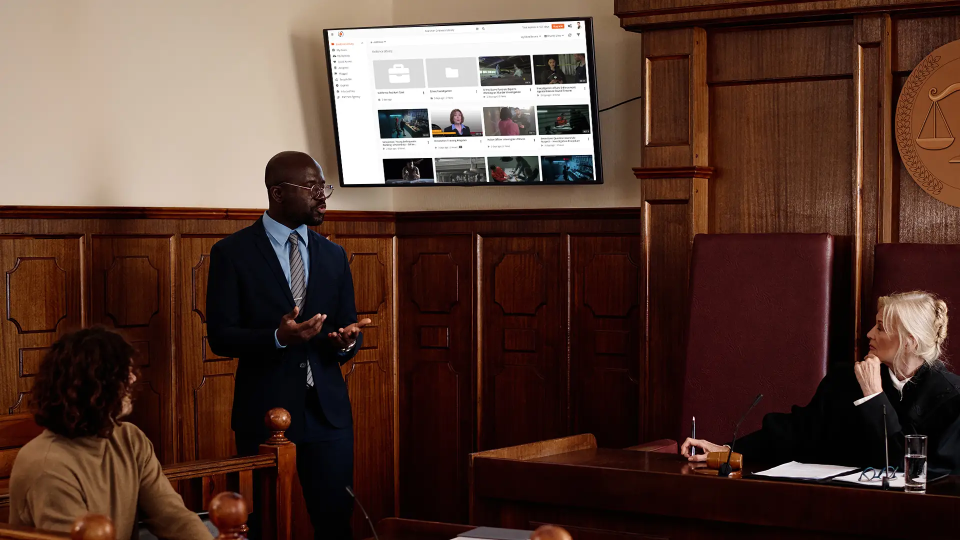
Presenting Video Evidence in Court
Evidence admissibility at trial depends on authentication: can the prosecution prove the video is what they claim it is, that it has not been altered, and that chain of custody from collection to courtroom is unbroken?
A DEMS addresses all three. Hash-based integrity verification detects any modification to a file after upload. If the hash recorded at ingest matches the hash at trial, the file is provably unaltered, which is a stronger authenticity argument than any testimony about how physical media was handled.
The system also produces a complete chain of custody report for any evidence item, logging every access, transfer, copy, and sharing event in an exportable format ready for court submission.
Some DEMS platforms also connect directly to courtroom presentation systems, allowing evidence to move from the prosecutor's portal into the trial without additional file transfers or format conversions.
For a detailed look at the authentication standards courts now expect from video evidence, Video Evidence Authentication: Standards Courts Expect in 2026 covers the evidentiary requirements specifically.
The Operational Case for Digital Evidence Management System in a Prosecutor's Office
The case preparation benefits compound across a full caseload. AI search and transcription cut footage review from hours to minutes. Systematic disclosure tracking reduces the risk of a Brady violation from a missed file. Immutable audit logs replace manual evidence handling records that were historically easy to challenge. Prosecutors walking into the courtroom have organized, presentation-ready evidence packages rather than a stack of USB drives sorted the night before.
For offices managing large caseloads across multiple courthouses and receiving evidence from dozens of contributing agencies, these are not marginal efficiency gains. They are the difference between a functioning case pipeline and a broken one.
VIDIZMO Digital Evidence Management System for Prosecutor Offices
VIDIZMO DEMS gives prosecutors a dedicated portal that operates independently from the law enforcement agency's evidence repository. Legal teams work in their own space, with their own access controls, without touching investigative files on the agency side.
The platform handles evidence from any contributing agency or device type without requiring those agencies to use VIDIZMO hardware. Evidence arrives in its original format. AI-powered search, transcription, redaction, and chain of custody reporting are built into the same workflow rather than handled by separate tools. CJIS compliance is supported across all deployment types.
For prosecutor offices dealing with growing evidence volumes and tighter disclosure timelines, the question is not whether to adopt a digital evidence management system. It is which one supports the full workflow from intake to trial, not just agency-side storage.
Managing terabytes of evidence across dozens of cases is hard enough. Getting it court-ready should not be. Talk to our team about how VIDIZMO Digital Evidence Management System fits into your prosecution workflow.

About the Author

Jump to
Which Digital Evidence Systems Support Multi-Client Segregation?

Secure Digital Evidence Disclosure: Redaction, Access & Audit Trails

No Comments Yet
Let us know what you think