
Handling the Evidence Surge During a Major Incident
By Ali Rind on June 23, 2026, ref:
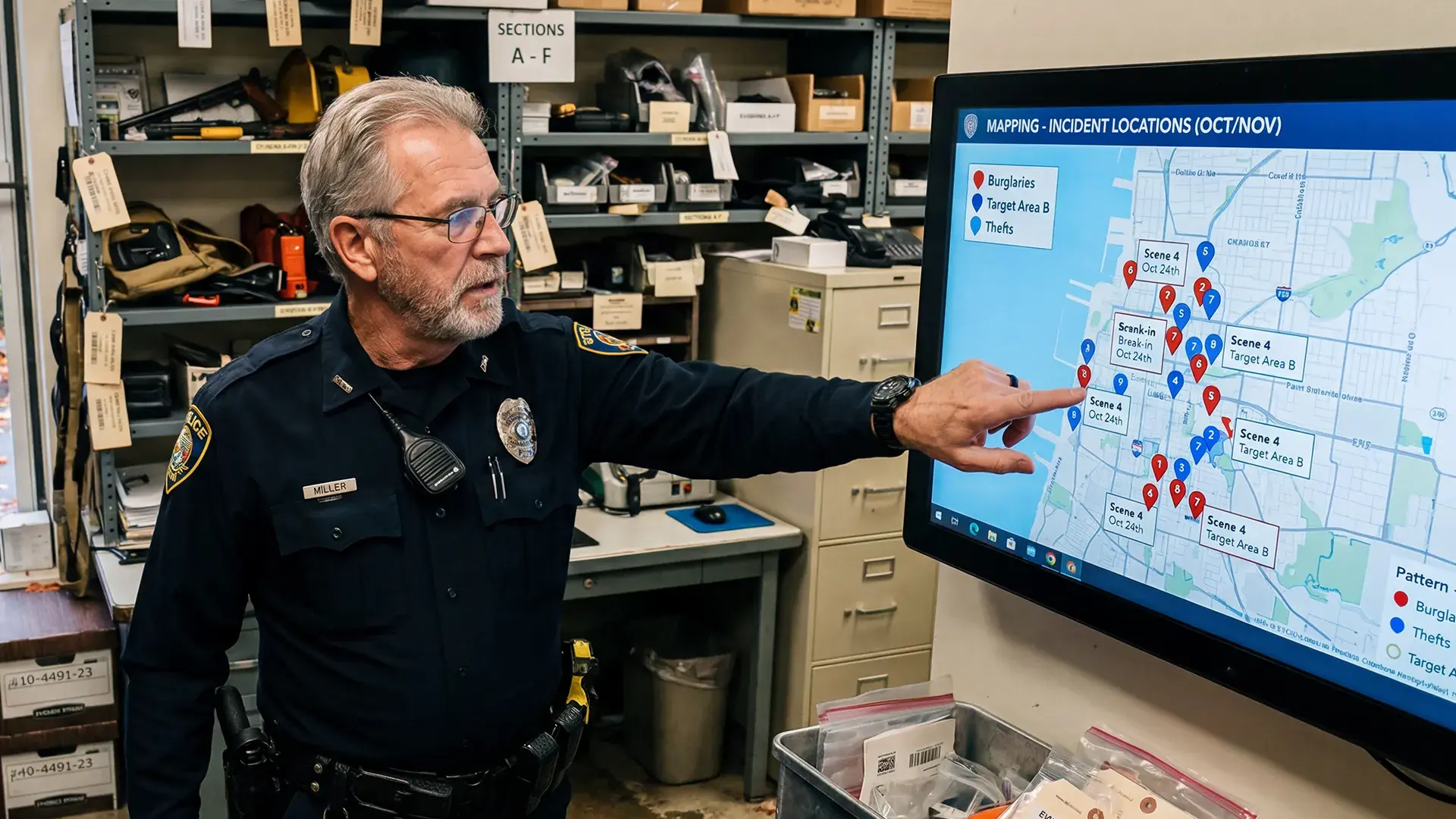
The January 6 Capitol investigation generated an evidence load on a scale few agencies will ever face. The Justice Department's discovery production included roughly 4,800 hours of Capitol surveillance video across nearly 17,000 camera files, plus about 1,600 hours of body-worn camera footage. The 2017 Las Vegas Strip shooting investigation reviewed thousands of hours of digital media drawn from CCTV, phones, and computers. Disaster response creates the same problem on compressed timelines. Every major incident produces an evidence surge that bears no resemblance to the daily flow your platform was designed for.
A digital evidence management system sized for a typical week of patrol is not the same as a system that can absorb 200 officers' worth of body-camera footage, 30 hours of CCTV from neighboring businesses, and a continuous stream of citizen submissions, all within one operational period. The day of a major incident is the wrong time to learn that distinction.
This guide walks through what major event evidence management actually requires, from surge ingestion through long-tail retention, and where most systems fail.
Major event evidence management is the discipline of ingesting, organizing, and disclosing the surge of digital evidence generated during mass incidents such as active shooters, civil unrest, disasters, and large planned events. A DEMS built for major events handles parallel ingestion from hundreds of sources, auto-groups evidence under a single case file, ingests mutual-aid contributions from partner agencies, and supports the bulk FOIA response that follows.
What Counts as a "Major Event" in Evidence Operations
Operationally, a major event is any incident that breaks the normal evidence flow. The scale, sources, agencies, or duration push your system into territory it was not designed for. The specific scenarios vary, but the patterns rhyme.
An active shooter response generates evidence from every responding officer, every responding agency, surrounding business CCTV, drone overwatch, and bystander phone footage. Civil unrest stretches the same problem across days and city blocks. A planned event like a presidential visit or a championship parade creates pre-positioned evidence assets that all activate at once when an incident occurs.
Natural disasters add a different dimension. Evidence collection happens across miles of jurisdiction, often without reliable network connectivity. Mass casualty crashes pull in federal investigators within hours, requiring evidence handoff to agencies with their own standards.
What ties these together is not the type of incident but the scale. When the evidence surge exceeds your normal weekly volume in a single shift, you are running a major event. Your DEMS either handles that surge or becomes the bottleneck in your response.
The Surge Problem: When Hundreds of Officers Upload BWC at Once
This is where most evidence systems quietly fail. A typical patrol day might generate 200 to 400 body-camera clips across an entire department. A major incident generates that volume in a single hour from one shift. When officers return to the station and begin uploads simultaneously, the ingestion pipeline matters more than any other feature in the platform.
Systems designed for steady-state operations process uploads sequentially. Each video gets transcoded, hashed, indexed, and stored before the next one starts. That works at 50 uploads per day. It breaks at 800 uploads per hour.
A DEMS built for surge processes uploads in parallel. Each incoming video runs its own ingestion thread. Storage tiers absorb the burst without requiring manual provisioning. The platform queues anything that exceeds capacity rather than failing or losing files. Officers see acknowledgment that their evidence is in the system, even if the deeper processing finishes later that night.
The practical test is whether your system stays responsive during the event or hits a wall. If your ingestion queue grows faster than it drains, you are not ingesting evidence anymore. You are storing it on a workstation while you wait for the upload to retry. More on this in our guide to managing body-worn camera evidence at scale.
Mutual Aid: Ingesting Evidence From Agencies You Don't Control
Major incidents almost never involve just one agency. State troopers respond. Federal partners (FBI, ATF, DHS) join within hours. Neighboring departments contribute under mutual aid agreements. EMS captures patient handoffs. Every one of those responders generates evidence that belongs to your case, even though none of it originates in your system.
The default workflow at most agencies is hard drives in evidence rooms, encrypted USB transfers, or secure email attachments. None of that scales during a major incident. By the time the after-action review starts, you have evidence in six formats stored in seven places, each with its own chain of custody log.
A DEMS that supports mutual aid lets partner agencies submit evidence directly into your case file with their identity preserved and source-tagged. The submission is logged, hashed, and joined to the rest of the incident automatically. Your custody chain shows exactly which evidence came from which agency, when, and through which mechanism. The platform handles the format conversion without changing the original.
This matters not just operationally but legally. Six months later, when defense counsel challenges the integrity of a video clip, you can show the unbroken chain from the contributing officer to the case file. See multi-agency evidence sharing for the broader workflow.
Auto-Grouping: How One Case File Holds 10,000 Pieces of Evidence
After a major incident, your evidence inventory looks impossible. Two hundred body-camera clips. Thirty CCTV pulls. Twelve drone passes. A hundred citizen tips. A dozen agency contributions. Dispatch audio. Interview rooms. Phone dumps. Every item belongs to the same incident, but assembling them into a single coherent case by hand takes weeks.
A DEMS designed for major events does this assembly during ingestion, not after it. The platform uses geolocation, timestamp, and incident tag to route every incoming piece of evidence to the same case file automatically. Officers do not have to manually select a case. CCTV imports do not require records-staff routing. Citizen submissions land in the right place because they reference the same incident identifier.
The case file itself stays organized. Sub-folders by source type. Filters by responding agency, by time window, by location. Search across everything in the case rather than browsing by file name. The structure scales whether the case holds 50 pieces of evidence or 50,000.
This is the difference between a case file and a case archive. One supports investigation. The other just stores data.
Real-Time Command Visibility vs Post-Incident Processing
A major event is two evidence workflows running at once. During the incident, command needs awareness. What is being captured, by whom, where, right now. After the incident, investigators need analysis. Searchable, indexed, redacted, ready for review.
Most evidence systems do one or the other. Real-time systems push live feeds to the command post but never settle that data into a permanent case file. Investigation systems index thoroughly but cannot ingest fast enough to support live command.
A DEMS built for major events runs both modes simultaneously. Live body-cam streams and drone feeds are visible in the command center as they arrive. The same evidence flows into the case file with full metadata, available for investigative search within minutes. AI processing (transcription, OCR, face and plate detection) kicks in after the immediate response, enriching the case file without delaying live availability.
The practical result: command makes decisions based on current evidence, and investigators do not lose anything to the rush. Both functions get what they need from the same source of truth.
The FOIA Tsunami That Follows Every Major Incident
Within 48 hours of any major incident, public records requests start arriving. Local media. National media. Civil rights organizations. Plaintiffs' attorneys preparing civil litigation. Citizens with legitimate interest. Within a week, you might face 50 to 100 times the FOIA volume of a normal month.
Manual processing of that volume is impossible. Redaction queues build. Statutory deadlines slip. Public trust erodes. Even agencies with strong day-to-day FOIA programs find their incident response paralyzed by the records workload that follows.
A DEMS that handles major events treats incident-related FOIA as its own workflow. Bulk redaction tools apply face and license-plate blurring across hundreds of videos in parallel rather than one at a time. Request management routes each incoming public records request to the relevant evidence subset automatically. Disclosure packages get assembled, packaged, and delivered without manual file handling for each one.
The system also tracks which evidence has been released to which requestor, what was redacted, and why. When a media outlet challenges a redaction or files a follow-up request, the records team has the audit trail to defend the decision in minutes, not days. See our guide to FOIA-compliant evidence management for the full disclosure workflow.
After-Action Review: Reconstructing the Timeline From Multi-Source Evidence
Every major incident generates an after-action review. Internal, often public, sometimes congressional or DOJ-led. The review requires a single coherent timeline of the event, reconstructed from every available evidence source.
The reconstruction is where multi-source evidence either becomes intelligence or stays a pile of files. A timeline drawn from one officer's body-cam tells one story. The same timeline that synchronizes that body-cam with overhead drone footage, the neighboring CCTV feed, and dispatch audio tells the actual story.
A DEMS that supports after-action review can play multiple synchronized sources against a single timeline. Investigators scrub to a specific timestamp and see what every available source captured at that moment. They can export a synchronized package for review boards, prosecutors, and oversight bodies without manually compiling videos in a separate editor.
Every access during the review is logged too, the same digital audit trail discipline that protects the underlying evidence: who accessed what, what they exported, and when, all available for the inevitable follow-up inquiries.
Long-Term Retention When the Case Never Closes
Major incident cases rarely close. Civil suits filed by victims or their families can extend ten years. Criminal cases pass through appeals, post-conviction motions, and federal review for similar periods. Investigative reopenings happen decades later when new techniques (DNA, AI-driven analysis) become available.
That extended timeline collides with normal retention schedules. The default rules for routine evidence do not apply when the case stays active. Manual tracking of which evidence falls under which hold becomes impossible at major-incident volume.
A DEMS handles this by attaching legal holds at the case level, not the file level. When a hold is placed, every piece of evidence under that case file inherits it automatically. Storage tiering moves older evidence to cold storage to manage cost without losing access. When a hold is eventually lifted, the system flags everything for disposition review rather than auto-deleting under the default schedule.
The cost of getting this wrong is spoliation in a years-later proceeding. The mechanics of holds, schedules, and lawful evidence retention and disposition are covered separately.
What to Do Next
The agencies that handle major incidents well are not the ones that buy more storage. They are the ones whose evidence systems were designed for surge before the surge arrived. Surge ingestion, mutual aid intake, automatic case assembly, real-time command visibility, bulk FOIA response, and indefinite retention are not features added after the first major event. They are foundational design choices that determine whether the platform supports the response or becomes the bottleneck in it.
For the broader evaluation framework, see the DEMS selection guide.
Ready to see how a modern DEMS handles your worst-case incident scenario? Request a demo and we'll walk through a major-event surge simulation specific to your agency's size and risk profile.
Frequently Asked Questions
Volume varies by incident scale, but it routinely runs to thousands of hours of combined video. The Las Vegas Strip shooting investigation reviewed thousands of hours of digital media, and the January 6 Capitol investigation's discovery production reached roughly 4,800 hours of surveillance video plus about 1,600 hours of body-worn camera footage. Multi-day civil unrest can push volumes higher still.
Through formal mutual aid agreements that name a lead agency for the incident. Modern DEMS platforms support direct submission from partner agencies into the lead agency's case file with chain of custody preserved, eliminating the hard-drive and USB transfer workflows that dominate informal sharing.
Major incident cases rarely close fully. Even after criminal prosecution ends, civil litigation and oversight inquiries often extend the active retention period to ten years or longer. Evidence stays under legal hold throughout, preventing default retention rules from triggering deletion.
FOIA and equivalent state public records laws apply normally, but volume escalates dramatically. Agencies that process major-incident records well treat the response as its own workflow rather than absorbing it into routine FOIA operations. Bulk redaction and request management capabilities determine whether statutory deadlines get met.
About the Author

Ali Rind
Ali Rind is a Product Marketing Executive at VIDIZMO, where he focuses on digital evidence management, AI redaction, and enterprise video technology. He closely follows how law enforcement agencies, public safety organizations, and government bodies manage and act on video evidence, translating those insights into clear, practical content. Ali writes across Digital Evidence Management System, Redactor, and Intelligence Hub products, covering everything from compliance challenges to real-world deployment across federal, state, and commercial markets.

No Comments Yet
Let us know what you think