
By Nadeem Khan on June 11, 2026

A joint task force pulls evidence from five different contributors. The local police department uploads body-worn camera footage. The sheriff's office drops off dashcam recordings on an external drive. A federal partner moves surveillance video over a secure file share. The state forensic lab forwards a hard drive with mobile device extractions. A hospital emails interior security footage.
Each agency uses different hardware, different naming conventions, and a different way of documenting what was collected and how. The lead agency has to turn all of that into one case file the prosecutor can take to trial.
This is where most joint investigations run into trouble, and the trouble starts at intake, long before anyone sees the inside of a courtroom. The handoff between contributing agencies is where chain of custody breaks, where file integrity becomes unverifiable, and where the defense eventually finds the gaps it needs to challenge admissibility.
The category does not have a widely accepted name yet. Some vendors call it cross-agency sharing, others call it federated evidence or partner submission. The underlying problem is the same. When more than one agency touches the same file, who owns the original, who logs the hash, and who can produce a clean chain of custody during discovery?
What follows is how multi-agency evidence intake actually works, where it commonly fails, and how a Digital Evidence Management System closes those gaps from the moment evidence enters the system.
Key takeaways
- Multi-agency intake is the workflow that decides whether a joint investigation's case file holds up in court. Most chain of custody failures originate here, not later.
- A defensible intake process needs three things: per-agency authentication, automated hash verification at upload, and consistent metadata capture across every contributor.
- Four failure points show up over and over: fragmented chain of custody at the handoff, inconsistent file naming and formats, missing source attestation, and undocumented contributor transfers.
- Federal Rule of Evidence 901 authentication starts at intake. Gaps introduced at the front door become admissibility challenges months later.
- A DEMS built for multi-agency work gives each contributing agency its own isolated tenant, accepts files in their original format, and produces one unified case view for the lead agency.
What is multi-agency evidence intake?
Multi-agency evidence intake is the process of receiving and consolidating digital evidence from two or more contributing agencies into a single case file, while preserving chain of custody from each source. The submitting agency uploads, the receiving agency verifies and routes, and a single immutable audit log records both sides of the transaction.
The category sits between two more familiar workflows. On one side is single-agency evidence management, where one department owns the entire lifecycle from collection to disposition. On the other side is public records or FOIA disclosure, where evidence leaves the criminal justice perimeter entirely. Intake is the middle ground. Evidence stays inside law enforcement, but it crosses organizational lines, and the integrity of the chain has to cross with it.
You see this workflow most often in:
- Joint task forces working drug trafficking, gang activity, human trafficking, or cybercrime cases
- Prosecutor offices receiving evidence from multiple contributing departments for a single case
- Mutual aid responses where several agencies respond to the same major incident
- Federal-state-local joint investigations with overlapping jurisdictional authority
- Internal affairs reviews involving officers from more than one department
- Cross-border or interstate cases where evidence was collected under different legal frameworks
The lead agency carries responsibility for what enters the case file. If a contributing agency's evidence cannot be authenticated, it does not just weaken that one piece. It puts the integrity of the entire investigation in question.
Why does multi-agency intake matter more in 2026?
Joint operations have grown in both volume and complexity since 2024. Federal task forces routinely pull body-worn camera footage from local partners. Regional fusion centers ingest tips and media from a dozen submitting agencies. Mutual aid responses to major incidents can generate thousands of files inside 72 hours.
The stakes have shifted with the volume. A single broken link in the custody chain can suppress an entire body of evidence at trial. Defense attorneys now train specifically on cross-agency handoffs because the seams between systems are where they win motions to suppress.
The Bureau of Justice Assistance has published guidance on multi-agency investigations through its Global Justice Information Sharing Initiative, which sets expectations for interagency data exchange. Most of that guidance assumes agencies already have a working intake mechanism. They usually do not.
The common mistake is to assume the receiving agency's existing evidence system handles the problem. It does not. Most digital evidence systems were designed for one agency, one case, one chain. The moment a partner agency needs to upload directly without a deputized user account, the workflow breaks.
How does evidence cross agency lines today?
-
Email attachments. Fast, familiar, and fatal for chain of custody. Mail servers strip metadata, compress media, and leave no immutable record of who received what.
-
USB drives and external hard drives. Still the dominant transfer method for high-volume video. Physical media requires a logged handoff, a hash verification on receipt, and a secure destruction record. Most agencies skip at least one of those steps.
-
FTP and SFTP. Better than email, but the receiving system rarely produces the chain-of-custody report a defense attorney will subpoena. Manual logging is still required on both ends.
-
Vendor cloud share links. Body camera vendors offer share links between agencies on the same platform. This only works when both agencies use the same vendor. In a regional task force with three different camera contracts, the workflow falls apart.
The part most teams overlook is the receipt side. A file arriving over any of these channels needs a logged ingest, a hash comparison against the source, and a documented decision about which case it joins. Without that, the original chain of custody from the submitting agency does not transfer. It ends at the agency boundary.
This is the workflow gap behind a broken chain of custody, one of the most common reasons digital evidence gets challenged or excluded in court.
What should a multi-agency intake workflow actually do?
A working intake pipeline has to handle seven things, each with its own audit trail.
- The contributing agency authenticates with its own credentials. Not a shared login. This establishes which agency uploaded which file, on the record, from the first action.
- Files are uploaded through the contributor's own intake channel, in their original format. No proprietary conversion. No re-encoding. The file the contributing officer collected is the file that lands in the case repository.
- A SHA-256 hash is generated the moment the file reaches the system. This becomes the integrity baseline every future verification will be measured against. If anything changes after that point, by even one bit, the hash will not match.
- Source attestation and metadata get captured automatically: contributor identity, source device, capture date and time, originating agency, and case reference. This is the foundation for Federal Rule of Evidence 901 authentication later.
- Evidence routes into the lead agency's case environment with contributor attribution preserved. The lead investigator sees one consolidated view of all evidence in the case, with each item clearly labeled to its source agency.
- Every transfer event between the contributing agency and the lead agency is timestamped and logged in a single tamper-evident audit trail. The log survives if either agency later leaves the task force.
- The case owner in the lead agency is notified when new evidence has been contributed, so review can start immediately instead of waiting for a manual handoff.
Standards bodies have begun to formalize these requirements. The NIST Computer Forensics Tool Testing program sets technical expectations for forensic acquisition that increasingly apply to digital evidence transfers between agencies.
Where does multi-agency intake usually break?
Most agencies do not lack the intent to handle multi-agency intake correctly. They lack the workflow to do it consistently across every contributor. These are the four points where it most often falls apart.
Fragmented chain of custody at the handoff
When evidence travels between agencies by USB, email, FTP, or physical media, the chain of custody breaks at every transfer point. The contributing agency can document what they collected internally. The lead agency can document what they received from that point on. The gap in the middle, the actual transfer, is where the record falls apart.
Inconsistent file formats, naming, and metadata
One agency names files using their internal case numbering: Case123_BWC_OfficerSmith.mp4. Another uses date-based conventions: 2025-04-15_Patrol_Unit_7.avi. A third sends a ZIP archive with files that have no metadata at all. A fourth uploads MP4s that have been re-encoded from the original camera output, which strips the embedded device metadata in the process.
Without normalization at intake, the unified case file becomes a search problem. A prosecutor preparing for trial cannot quickly find all evidence relating to a specific officer, timeframe, or incident location, because the contributing agencies all described those things differently.
Missing or inconsistent source attestation
The court will eventually ask: who recorded this file, on what device, under what authority, and how was it transferred to the agency presenting it? If that information lives in five different agency systems, in five different formats, the prosecutor has to reconstruct it manually, often months after the fact. Information that is easy to capture at the moment of intake becomes nearly impossible to reassemble later.
This is one of the common reasons digital evidence is rejected in court. Missing or inconsistent source documentation creates doubt about authenticity, and doubt is enough to trigger an admissibility challenge.
Verification gaps that surface at trial
The defense will scrutinize every contributor handoff. Any gap in the intake record, whether it is a missing hash value, an undocumented transfer, unclear contributor identity, or a file that arrived without source metadata, becomes a Federal Rule of Evidence 901 authentication challenge.
Under FRE 901, the proponent of evidence must produce enough information to support a finding that the item is what they claim it is. In multi-agency cases, that burden falls on the lead agency to demonstrate authentication for every contributed file, not just the ones their own officers collected.
How should agencies govern access across jurisdictions?
Access control is where most intake implementations either succeed or fail in court. A federal investigator working a joint case with a local sheriff should see the evidence relevant to that case, nothing more. The sheriff's other case files stay walled off. Internal affairs files from either agency stay walled off from everyone.
Portal-based architectures handle this cleanly. Each agency gets its own portal with independent security settings, retention policies, and user directories. A joint task force gets a shared portal with members from both agencies and explicit access boundaries per case. This model holds up under defense scrutiny when single-tenant systems with shared accounts do not.
Role-based access control inside each portal has to align with CJIS expectations. The FBI CJIS Security Policy, Section 5.5 on access control, requires individually identifiable user accounts, role-based permissions, and audit logging for every access event involving criminal justice information. Shared logins or vendor admin accounts do not meet that bar.
How does a digital evidence management system solve multi-agency intake?
A purpose-built Digital Evidence Management System addresses each failure point at the workflow level. The fix is structural, not procedural, which means it does not depend on every contributing agency following identical internal procedures. Each agency uploads through its own isolated tenant with its own credentials, retention rules, and audit logs, while the lead agency sees a unified view across all contributors when working a joint case.
Hash verification happens automatically the moment a file lands, before anyone touches it. The system accepts files in their original format from body-worn cameras, dashcams, interview rooms, mobile device extractions, VMS exports, and third-party surveillance, without forcing contributors onto the lead agency's hardware. VIDIZMO Digital Evidence Management System handles 255+ media formats at intake without manual transcoding, and metadata is captured in a consistent schema across every agency, so the unified case file stays searchable across all contributed evidence.
Every transfer event between contributing and lead agencies is logged in a single, continuous chain of custody record. Access stays granular within the unified case, controlled by role and case assignment rather than by which contributor uploaded the file, so a prosecutor can be given access to evidence from three of the five contributing agencies and not the other two. For the broader discipline this connects to, the guide on maintaining chain of custody covers what defensible evidence handling looks like end to end.
If your agency is standing up a joint task force, a regional fusion center, or a mutual-aid intake workflow, the platform supporting it needs to be designed for cross-agency intake from the start, not retrofitted later. Book a demo to see how portal-based intake handles your specific jurisdiction and partner setup.

What compliance standards apply to cross-agency intake?
Authentication under Federal Rule of Evidence 901 does not start at trial. It starts at intake. If the system cannot prove who contributed a file, when, from what device, and that it has not been altered since, the whole evidentiary chain becomes vulnerable.
For agencies handling Criminal Justice Information, intake also has to meet several federal and international standards across every contributing agency tenant, not just at the lead agency level.
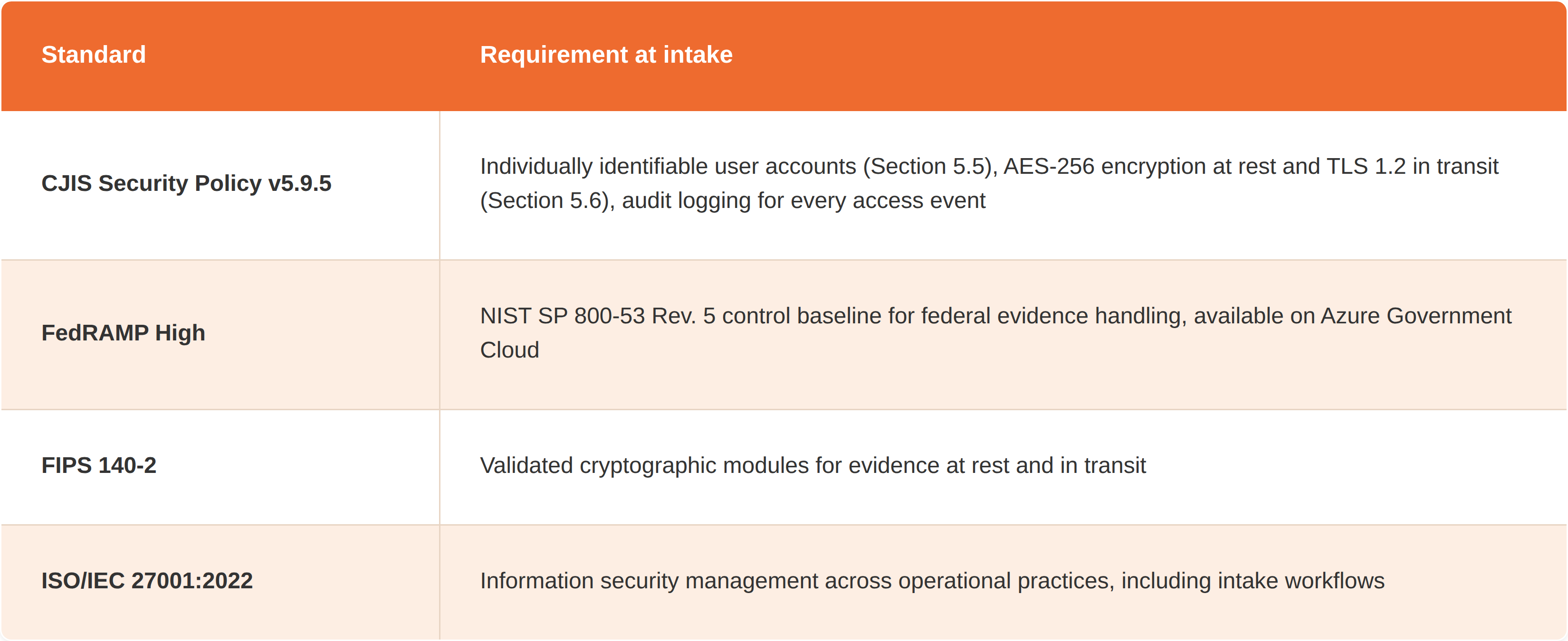
There is also a Brady disclosure angle worth thinking through. When contributing agencies hold evidence the lead prosecution team does not know about, the agencies in possession may have Brady obligations the prosecution team is not in a position to fulfill. A unified intake process closes this gap by making contributed evidence visible to the lead agency from the moment it is uploaded.
The guide on digital evidence admissibility for prosecutors walks through the FRE 901 requirements in more depth, along with the most common ways admissibility gets challenged in court.
What should agencies look for in a multi-agency intake solution?
If you are evaluating how to handle multi-agency intake, these are the questions that separate purpose-built solutions from generic file sharing tools.
- Does the system support contributing agencies that are not on the lead agency's hardware?
- Are contributing agencies kept in isolated tenants, or do they share a single environment that mixes their data?
- Is hash verification automatic at upload, or a manual step a contributor can skip?
- Does the system preserve original file formats without proprietary conversion?
- Can the chain of custody report show every handoff between contributing and lead agencies, end to end, in one document?
- Are intake workflows configurable per contributing agency, so each one can follow its own internal procedures while still feeding the unified case file?
- Does the system meet CJIS Security Policy requirements across every tenant in a multi-agency deployment?
These questions move the evaluation from "can we share files" to "can we defend the case." That is the line that matters when the evidence reaches court.
Frequently Asked Questions
What is multi agency evidence intake?
Multi agency evidence intake is the workflow for accepting digital evidence from one or more partner agencies into a primary case file, with verified chain of custody preserved across the transfer. It typically includes an authenticated submission portal, hash verification at ingest, automatic routing to the correct case, and a single tamper-evident audit log covering both sides of the handoff.
How is multi agency intake different from regular evidence management?
Single-agency evidence management assumes one organization owns the full lifecycle, from collection to disposition. Multi agency intake adds the harder problem of preserving chain of custody when evidence crosses organizational boundaries, with different user directories, different retention policies, and different access controls on each side. VIDIZMO DEMS handles this through a portal-based architecture that keeps agencies separate while supporting joint cases.
Why can't agencies just share evidence over email or shared drives?
Email strips metadata and compresses media, which breaks the original hash. Shared drives rarely produce the chain-of-custody report a defense attorney will subpoena. Neither method logs the receipt event in a way that survives later discovery, which is why intake routinely surfaces as a vulnerability in cross-agency cases.
How does chain of custody transfer between agencies?
Chain of custody transfers cleanly only when the receiving system logs the handoff with the same rigor the submitting agency applied. That means an authenticated upload, a SHA-256 hash comparison on ingest, the submitting user and agency captured in the audit log, and an exportable report covering both sides. Without those four elements, the original chain effectively ends at the agency boundary.
Does cross-agency intake need to be CJIS-compliant?
Yes, whenever the evidence qualifies as Criminal Justice Information. The FBI CJIS Security Policy, Section 5.5 (Access Control) requires individually identifiable user accounts, role-based permissions, and audit logging for every access event. Sharing a vendor admin login between agencies or routing files through a non-compliant intermediary breaks the policy and creates a discoverable gap.
Can a task force use one platform if member agencies have different evidence systems?
Yes, and this is the most common deployment pattern we see. The task force operates a shared portal on the receiving platform, while each member agency keeps its existing system for non-task-force work. Submitting agencies upload to the shared portal through authenticated intake, which preserves their internal chain of custody while contributing evidence to the joint case file.
What deployment model fits a regional task force best?
For task forces under 500 sworn personnel, Gov Cloud is usually the right call. The capital expense of on-prem hardware rarely pays back at that scale, and Gov Cloud satisfies CJIS and FedRAMP High requirements without each agency standing up its own infrastructure. Larger operations or classified environments may justify hybrid or on-prem deployment.
About the Author

Jump to

The Complete FOIA Evidence Preparation Workflow: From Request to Release

Court Exhibit Preparation: A Practitioner's Field Guide for Trials
.webp)

No Comments Yet
Let us know what you think