
By Ali Rind on June 11, 2026

A prosecutor's office evaluating digital evidence management software in 2026 will, sooner or later, end up looking at two options. VIDIZMO Digital Evidence Management System and Axon Justice. They are built on different assumptions, and the difference between them comes down to four questions every evaluator should answer before signing anything.
Both can run a prosecutor's office. Which one fits depends on details that do not show up in a feature list, like what your upstream agencies use and how much flexibility you want in three years.
This is an honest comparison. Where Axon Justice is genuinely strong, we say so. Where VIDIZMO has a structural advantage, we say that too.
The four questions that actually matter
Where does your evidence come from?
I'll do a quick pass over the existing site content from earlier in our conversation to pick the strongest matches, then place them where the prose actually calls for them.
A prosecutor's office evaluating digital evidence management software in 2026 will, sooner or later, end up looking at two options. VIDIZMO DEMS and Axon Justice. They are built on different assumptions, and the difference between them comes down to four questions every evaluator should answer before signing anything.
Where does your evidence come from? How much deployment flexibility do you need in three years? Do you want AI bundled into the platform or kept optional? And does your pricing model match how your office actually uses the system?
This is a direct comparison from the team behind VIDIZMO DEMS. We have a point of view. We will tell you where Axon Justice fits and where it does not, but we are not pretending to be neutral.
The four questions that actually matter
Where does your evidence come from?
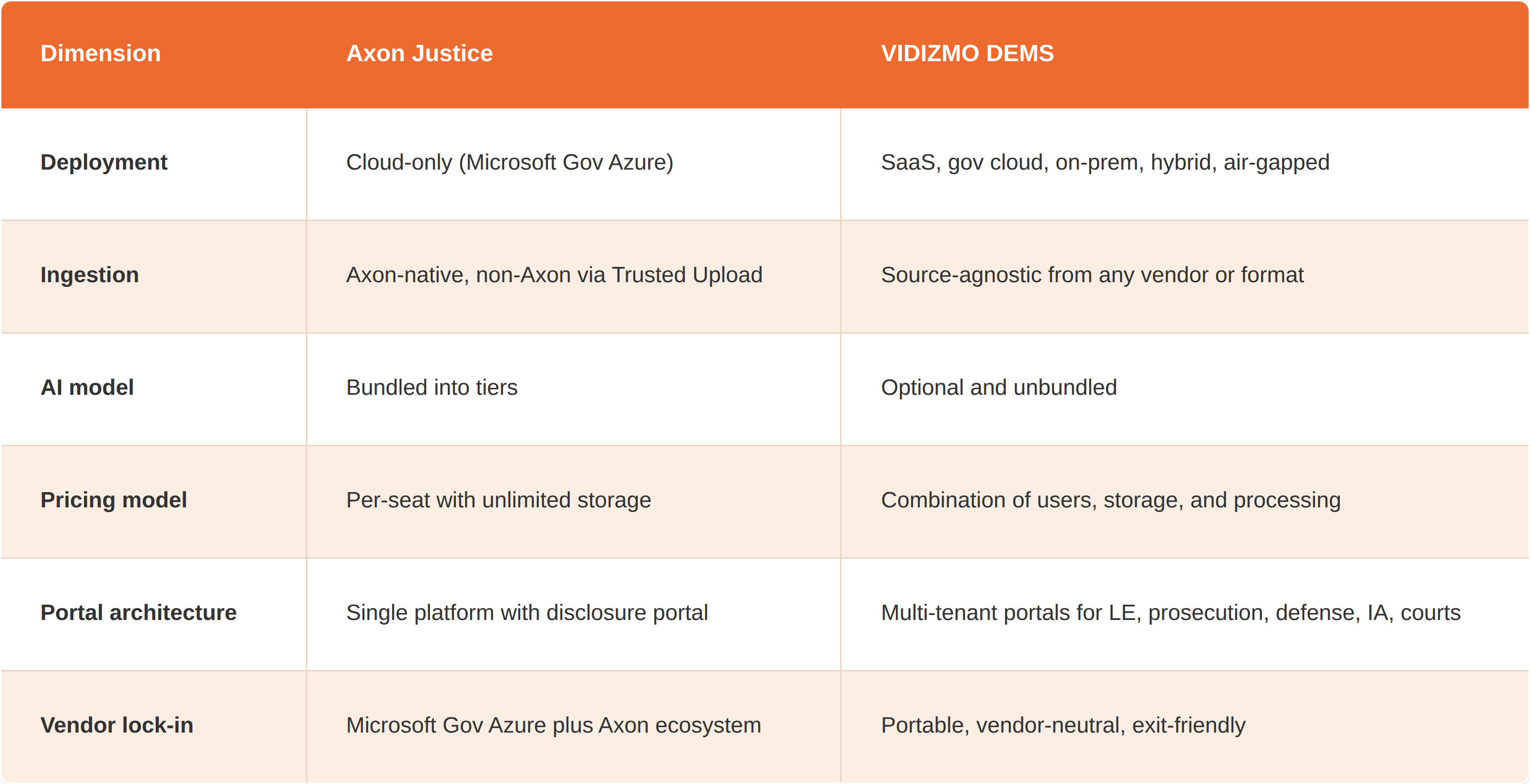
Most prosecutor offices receive evidence from multiple upstream agencies, and those agencies rarely share a platform. The sheriff might be on Coreforce. The city PD might be on Digital Ally or Axon. The state police runs its own. Federal task force evidence arrives separately.
Axon Justice was built around Axon devices first. Evidence from Axon body cameras flows in automatically. Anything else flows through Trusted Upload and Third Party Video Playback, which work, but they treat non-Axon sources as a secondary path.
VIDIZMO ingests from any source in any format with no preferred vendor. Coreforce, Axon, Digital Ally, NICE, Motorola, citizen submissions, in-house recordings. All treated the same.
If your upstream is 100% Axon, this question does not matter much. If your upstream is mixed, and most county prosecutor offices we have worked with are, this is the largest practical difference between the two platforms. A DEMS that favors one upstream vendor recreates the fragmentation problem it is supposed to solve. The right question to ask each vendor is what happens when you add a new agency next year on a platform they have never seen.
How much deployment flexibility do you need?
Axon Justice runs cloud-only on Microsoft Government Azure. That is the only option.
VIDIZMO runs in SaaS, government cloud, on-premises, hybrid, and air-gapped environments.
For most county prosecutor offices, cloud-only is acceptable today. CJIS and FedRAMP High both cover criminal justice information in cloud environments, and Axon Justice meets the standards. The question is what happens in three to five years. County data sovereignty policies change. Federal task force assignments come with requirements that did not exist when you signed the contract. IT directors decide to bring evidence back in-house. We have spoken to offices that started in cloud and were forced to migrate out within four years for reasons that had nothing to do with the vendor's performance. Optionality is insurance.
Do you want AI bundled or optional?
Axon's AI features are tightly integrated into the platform's tiers. Auto-transcription comes with Premier. Brief One requires Premier Plus. There is no AI-off configuration that keeps the rest of Premier intact.
VIDIZMO unbundles AI completely. Redaction, transcription, summarization, and visual analysis are available as separate line items. An office can subscribe to evidence management and skip AI entirely.
The conversation we have most often with prosecutor leads is some version of: we want the evidence management, we are not ready for the AI, can we just buy the part we need. On VIDIZMO, yes. On Axon Justice, you take the bundle. For offices under public scrutiny, working within state policy that limits algorithmic analysis of evidence, or simply not ready to budget for AI yet, that difference is operational, not philosophical.
How they compare on architecture
Where Axon Justice fits
Axon Justice works best for offices in an Axon-dominant environment. If your sheriff runs Axon Body cameras and your city PD does too, and you are comfortable on cloud, and you want AI built in, Axon Justice will work for you. It is not the wrong answer for that profile.
Where VIDIZMO DEMS fits
Axon Justice works for offices in an Axon-dominant upstream environment that are comfortable on cloud and want AI built in. If your sheriff and city PD both run Axon Body and you are not worried about deployment flexibility five years out, it is not the wrong answer for that profile.
VIDIZMO is built on the assumption that the prosecutor's office is the convergence point for evidence from every upstream system. Source-agnostic by design. Deployment options because government IT requirements change. AI unbundled because not every office wants it. Pricing broken into parts because not every office uses the system the same way.
If your office sits downstream of multiple law enforcement agencies on different platforms, needs deployment options now or later, wants AI as a choice rather than a default, or wants a separate scaled-down public defender portal for disclosure, this is the platform built for your environment.
A practical evaluation checklist
If you are running an active evaluation, work through these in order:
- Map every upstream agency that hands you evidence. Write down which platform each one uses, even if you have to call IT to find out.
- Ask each vendor how they ingest from each of those platforms specifically. Push past the "we support any source" answer.
- Decide whether cloud-only deployment is acceptable for the next five years, then ask your county IT director to confirm.
- Decide whether you want AI bundled or available as a separate line item, then check whether your office has a written policy on algorithmic analysis of evidence.
- Build a real seat count and a real storage projection from your last 12 months of data. Ask each vendor to quote against your actual numbers.
- Ask both vendors how they handle retention by case type, chain of custody and audit trail, and Brady disclosure obligations.
- Ask both vendors what happens when you add a new agency next year on a platform they have never seen. Their answer tells you everything.
Want to see how VIDIZMO Digital Evidence Management System handles your specific evidence sources and workflow? Book a 30-minute walkthrough with our team.

About the Author

Jump to

Best Axon Evidence Alternative for Law Enforcement

How AI Is Reopening Cold Cases: Evidence Management for Investigations


No Comments Yet
Let us know what you think