
By Ali Rind on June 2, 2026

The insurance industry generates more claims evidence today than at any point in its history. Dashcam videos, drone surveys, smartphone photos, telematics data, and recorded statements now accompany routine claims, creating a volume of multimedia content that manual review processes cannot efficiently handle.
AI claims processing automation addresses this challenge directly. By applying artificial intelligence and machine learning to evidence analysis, triage, and decision support, carriers can reduce cycle times, improve accuracy, and scale claims operations without proportional staffing increases.
This article explores the specific AI and automation capabilities that are reshaping how insurance carriers process claims and what to evaluate when selecting a platform. For a broader view of how digital technology is transforming the entire claims lifecycle, see our complete guide to digital claims processing.
Where AI Delivers the Greatest Impact in Claims Processing
Not every step in the claims lifecycle benefits equally from AI. The highest-value applications target tasks that are repetitive, evidence-intensive, or time-sensitive.
FNOL Triage and Routing
When a claim arrives, AI can analyze initial submissions, including photos, descriptions, and policy data, to estimate severity and route the claim to the appropriate team. Low-complexity claims move to fast-track automated processing. High-severity or potentially fraudulent claims route to senior adjusters or SIU teams. This automated triage eliminates bottlenecks at intake and ensures that adjuster time is allocated to claims that require human judgment.
Evidence Analysis at Scale
The most time-consuming element of claims handling is reviewing evidence. A single property claim may include 50 or more photos. An auto claim may involve 30 minutes of dashcam video from multiple angles. Adjusters spending hours reviewing this evidence manually creates backlogs and delays.
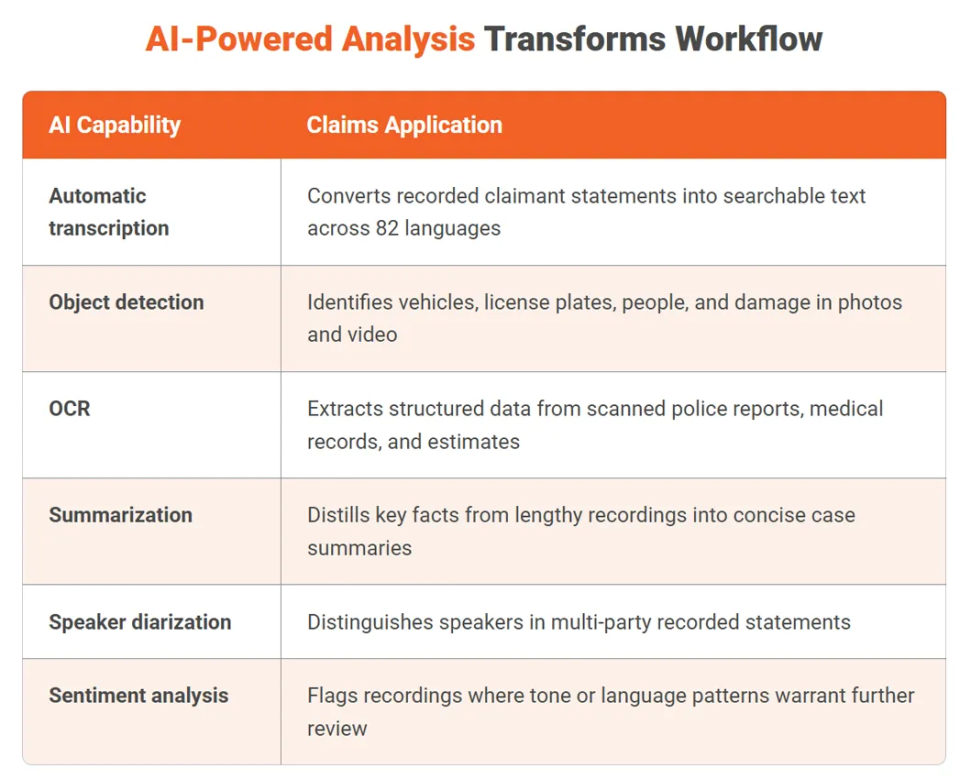
AI changes that from a linear task into a searchable one. When evidence enters the system, it is indexed on upload rather than waiting for an adjuster to open each file. Recorded statements are transcribed automatically and made searchable by keyword. Photos and video are scanned for vehicles, license plates, faces, and damage patterns, so an adjuster can query for a specific detail instead of scrolling through hundreds of images or scrubbing through footage.
The workflow around that analysis is automated too. When a claim is filed, the system pulls in the associated evidence, categorizes it, and notifies the assigned reviewers. Adjusters shift from collecting and sorting files to acting on findings, which is where their judgment actually adds value.
AI-Powered Fraud Detection
Fraud is one of the largest drains on the industry. Insurance fraud costs the United States an estimated $308.6 billion annually, with property and casualty lines accounting for roughly $45 billion of that total. Manual fraud review depends on an adjuster noticing something off, which does not scale across rising claim volumes.
AI surfaces the inconsistencies that manual review misses. It checks photo and video metadata for timeline mismatches, such as an image captured before the reported incident date, cross-references a claimant's recorded statement against the physical evidence on file, and identifies patterns across related claims that point to organized fraud. Flagged claims route to special investigations teams earlier, before a questionable claim escalates into a payout.
Compliance Automation
AI-driven retention policies automatically manage evidence lifecycle requirements, applying hold rules when litigation is pending, enforcing state-specific retention periods, and triggering disposition when retention windows expire. This reduces compliance risk and eliminates the manual tracking that consumes records management resources. For the full picture of the frameworks involved, see our guide to compliance standards for evidence handling.
What to Look for in an AI Claims Processing Platform
Not all AI platforms are equally suited to insurance claims. Evaluate candidates against these criteria.
Multimedia-First Architecture
Claims evidence is increasingly visual, encompassing video, photos, and audio. Generic document management systems struggle with multimedia. The platform must handle various formats natively, with built-in playback, annotation, and AI analysis for video and audio content.
AI Accuracy and Language Support
Automatic transcription must be accurate across accents, dialects, and languages. For carriers serving diverse policyholder populations, support for more languages with documented accuracy benchmarks is essential. AI that does not train on customer data by default is also a critical privacy consideration.
Deployment Flexibility
Not every carrier operates in the cloud. The platform should support cloud, on-premises, hybrid, and government cloud deployments, allowing IT teams to align with existing infrastructure and security requirements without compromise. Carriers with strict data residency requirements should weigh this carefully, since a platform that only offers public cloud will not work for insurers subject to state-level data handling rules or those managing claims involving government entities. For a closer look at hosting options, see our overview of flexible evidence management deployment.
Integration Capabilities
Claims platforms do not operate in isolation. The AI platform must integrate with existing policy administration systems, claims management systems, and communication tools through APIs and standard connectors.
Security and Compliance
Insurance claims contain sensitive personal information. The platform must provide AES-256 encryption, role-based access control, multi-factor authentication, complete audit logging, and support for HIPAA, GDPR, and state privacy regulations.
How VIDIZMO DEMS Applies AI to Claims Evidence
VIDIZMO Digital Evidence Management System (DEMS) is a purpose-built platform for managing multimedia evidence with integrated AI capabilities. For insurance claims operations, DEMS delivers:
- Automatic transcription across 82 languages, converting recorded statements, interviews, and call recordings into searchable, indexable text
- Object detection that identifies vehicles, license plates, faces, and damage patterns in claim photos and video
- AI-powered search that enables adjusters to find specific moments in hours of video by searching spoken words, detected objects, or visual content
- Summarization that extracts key findings from lengthy recordings, reducing review time from hours to minutes
- Tamper detection using SHA-256 hashing to verify evidence integrity throughout the claims lifecycle
See how VIDIZMO DEMS can reduce claims review time and improve accuracy at your organization. Request a personalized demo today.

Building a Faster, Smarter Claims Operation
AI claims processing automation is not a future aspiration. It is an operational imperative for carriers facing growing evidence volumes, rising customer expectations, and persistent fraud challenges. The carriers that deploy AI-powered evidence analysis, automated workflows, and intelligent triage today will process claims faster, more accurately, and at lower cost than those still relying on manual review.
The key is selecting a platform built for the multimedia evidence that defines modern claims, one with proven AI accuracy, deployment flexibility, and the security controls that insurance regulators require. If you are starting that evaluation, our digital evidence management system selection guide walks through the criteria that matter most.
About the Author

Jump to

What Is Digital Claims Processing? Complete Guide for Insurance Carriers

Drawbacks of Manual Evidence Review in Criminal Case Management


No Comments Yet
Let us know what you think