
By Rafay Muneer on June 5, 2026
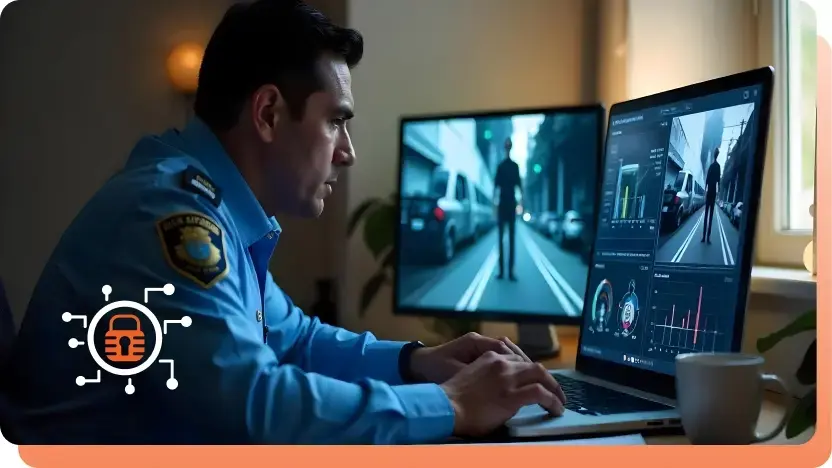
Reviewing video evidence can be a time-consuming and resource-intensive process. Here's how AI-powered video analysis speeds it up, and what it takes for AI-assisted findings to hold up in court.
Say you're in the middle of a high-stakes criminal investigation. The case hinges on a mountain of video footage, sometimes hours, even days of content, but every minute counts. Your team is up against the clock. How do you sift through countless frames, identify key suspects, and present evidence that survives scrutiny? This is where AI-powered video evidence analysis steps in, turning an overwhelming task into a manageable one.
The painful reality is that many law enforcement agencies, legal teams, and compliance officers still rely on manual, error-prone methods for analyzing video evidence. This is inefficient, and it leaves critical details unfound. This post focuses on video footage specifically: body-worn cameras, CCTV, dashcams, and interview recordings. For how AI applies across documents, audio, and images, see our complete guide to AI for digital evidence analysis.
Overwhelming Volumes of Video Evidence
In a world where cameras are omnipresent, the amount of video evidence generated is staggering. From police body cameras to CCTV footage, investigators and legal teams are buried under an avalanche of data. This flood of evidence presents three significant challenges:
- Volume: Manual video analysis is labor-intensive and time-consuming. Reviewing hours of footage to find a few seconds of critical evidence can take days or even weeks, because manual review takes at least as long as the footage runs.
- Accuracy: Human error is inevitable, especially when analysts are fatigued from reviewing endless footage. Key details, such as a face in the background or a partial license plate, can easily be overlooked in hour six of review.
- Consistency: Two reviewers watching the same footage will flag different moments and apply different thresholds for what counts as relevant. Without a systematic first pass, relevance decisions live entirely in individual judgment.
These challenges have real consequences. For law enforcement, delayed evidence analysis can mean lost cases. It is estimated that the average case takes ten months to resolve. For legal teams, overlooked details can weaken arguments in court. For compliance officers, improper handling of sensitive video data can lead to legal penalties.
The Costs of Inaction
Let’s dig deeper. What happens when these problems go unresolved?
- Case Backlog: As video evidence accumulates, investigative teams may struggle to keep pace, resulting in case backlogs. In the criminal justice system, delays can result in the denial of justice.
- Legal Risks: For legal professionals, the risk of presenting incomplete or inaccurate video evidence is significant. A single error can undermine a case or result in wrongful convictions, which can have career-altering implications.
- Compliance Nightmares: For industries such as finance or healthcare, video evidence must comply with stringent privacy laws, including the GDPR. Manual redaction is not only inefficient but also prone to error, putting organizations at risk of hefty fines and reputational damage.
- Missed Insights: In corporate security and insurance fraud investigations, the failure to detect subtle yet crucial details in video footage can result in costly errors, missed threats, or fraudulent claims that go undetected.
Without a solution, teams will continue to struggle with overwhelming workloads, mounting pressure, and the risk of making costly mistakes.

AI-Powered Video Evidence Analysis
AI-powered video evidence analysis addresses these problems by automating the first pass over footage and surfacing the segments a human should review. The point is triage, not verdicts. Here's how it works:
Automated Video Review: Faster and More Accurate
AI can process hours of footage within minutes, detecting and tagging people, vehicles, license plates, and objects of interest with timestamps. An investigator searching for a specific vehicle no longer scrubs through 40 hours of intersection footage in real time. The system returns every segment where a match appears, and the investigator reviews those segments directly. AI transcription extends this to spoken audio: the soundtrack of body camera and interview footage becomes searchable, time-coded text, so a name or address can be found across an entire case's footage in seconds. When an incident spans multiple cameras, AI-assisted analysis aligns the sources on a common timeline so reviewers can follow events across feeds instead of reconciling timestamps by hand.
Bias-free Evidence Analysis
AI applies the same detection criteria to every second of footage, in hour one and hour forty alike. It does not get tired, and it does not skim. That consistency is the honest claim, and it is different from claiming AI is unbiased. NIST's landmark study of face recognition algorithms found that most exhibit demographic differentials, meaning accuracy varies across age, sex, and racial groups. Detection performance also degrades in low light, crowds, and low-resolution footage. This is why credible AI analysis keeps a trained human reviewer in the loop for every consequential determination. Agencies that document this human review process present far stronger evidence than those that treat AI output as self-validating.
Enhanced Video Redaction
One of the most valuable features of AI-driven tools is their ability to redact sensitive information automatically. AI detects faces, license plates, and other personal data, tracks them across frames, and blurs them quickly, with a human verification pass before release. This supports GDPR compliance and public records obligations, reducing the risk of privacy violations and fines. It streamlines the process of anonymizing video data, making it easier to share with prosecutors, defense counsel, and the public while protecting the identities of bystanders and minors. Manual frame-by-frame redaction of an hour of footage can take days; AI-assisted redaction reduces it to a review task.
Chain of Custody Management
Every action taken on video evidence, from ingestion through analysis, redaction, and export, should be tracked in a tamper-evident audit log with hash verification of the original file. This is critical in legal proceedings where the integrity of evidence is often called into question, and it becomes more important, not less, when AI is involved. If footage was processed by a model, the record must show what was done, when, by which system version, and that the original evidence remained unaltered throughout the evidence lifecycle.
AI-Powered Video Analytics
Beyond review and redaction, AI provides deeper insights from video evidence through advanced analytics. AI can analyze crowd movements, detect anomalies, or identify patterns of behavior that might not be immediately obvious to a human reviewer working through footage linearly. These analytics flag activity for human assessment, reducing reliance on manual surveillance without removing human judgment from the decision.
Will AI-Assisted Video Analysis Hold Up in Court?
This question should shape every tool and workflow decision in 2026, because the rules are actively changing. In 2025, the Judicial Conference's Standing Committee published proposed amendments to the Federal Rules of Evidence that directly address machine-generated evidence, including a new Rule 707. Under the proposal, machine-generated evidence offered without an expert witness would need to meet the same reliability standards as expert testimony: based on sufficient facts or data, produced through reliable principles and methods, and reliably applied to the facts of the case. The public comment period closed on February 16, 2026, and the proposal is now under committee review.
Whatever final form the rule takes, the direction is clear. Courts intend to scrutinize AI-derived findings the way they scrutinize human experts. At the same time, generative AI has made fabricated video cheap to produce, so authenticating footage under Rule 901 increasingly depends on hash values captured at ingestion, preserved metadata, and a documented chain of custody.
The practical takeaway: adopt tools and build workflows that assume you will have to explain them under oath. Documented model versions, human review checkpoints, preserved originals, and complete audit trails turn AI findings into defensible evidence. Without them, the same findings become a liability.
Key Takeaways
- AI accelerates video review: AI-powered analysis processes hours of footage in minutes, letting investigators locate critical segments in a fraction of the time manual review requires.
- Consistency, with human verification: AI applies the same scrutiny to every frame without fatigue, while trained reviewers verify findings, since detection accuracy varies with footage quality and, per NIST, across demographic groups.
- Automated redaction for compliance: AI redacts faces, license plates, and personal data with human verification, supporting GDPR compliance and public records deadlines.
- Secure chain of custody: Hash verification and tamper-evident audit logs document every action on the footage, preserving its integrity for legal proceedings.
- Courtroom readiness is the new bar: Proposed Federal Rule of Evidence 707 would hold machine-generated evidence to expert-testimony reliability standards, so documentation and human review are what make AI findings admissible, not just useful.
Why AI-Powered Video Evidence Analysis is Essential for Today's Professionals
The application of AI in video evidence analysis isn’t just a “nice-to-have” anymore, but it’s a necessity for professionals dealing with large volumes of video data. Whether you’re a law enforcement officer, a legal professional, or a compliance officer, the benefits of AI are clear:
- Efficiency: AI significantly reduces the time required to review, analyze, and manage video evidence.
- Accuracy: With AI, you can trust that no detail will be overlooked.
- Security: AI ensures that video evidence is handled securely, with full compliance and a transparent chain of custody.
Investing in AI-powered video evidence analysis tools isn’t just about staying ahead of the curve; it’s about delivering justice, ensuring compliance, and protecting organizational integrity.
How VIDIZMO DEMS Supports AI Video Evidence Analysis
VIDIZMO Digital Evidence Management System is built around this workflow. Footage from body-worn cameras, CCTV, dashcams, and other sources is ingested with hash verification, then processed with AI capabilities including face, object, and license plate detection, speech transcription and translation, and automated redaction with human-in-the-loop review. Every action is recorded in a tamper-evident audit log, and the platform is CJIS compliant for law enforcement deployments. When an analysis or redaction is challenged, the agency can show exactly what was done and prove the original file is intact. You can request a free trial to evaluate it against your own footage.

About the Author
Jump to
AI in Digital Evidence Analysis: A Practical Guide for Investigators
.webp)
6 Best Practices for Video Evidence Analysis in Government Cases


No Comments Yet
Let us know what you think